
More campers have been cold in a “20-degree bag” at 30 degrees than in any other gear failure we know. The bag usually was not lying, exactly — it was quoted in a language most buyers never learn. Sleeping bag ratings come in kinds: a comfort rating means a typical sleeper stays warm; a limit rating means a curled-up sleeper does not die; and a rating with no standard behind it can mean anything at all. Then the ground takes its share. This calculator translates your bag’s printed number into the coldest night you should actually plan on — with your pad and your own thermostat counted.

Translate your bag
—
—
—
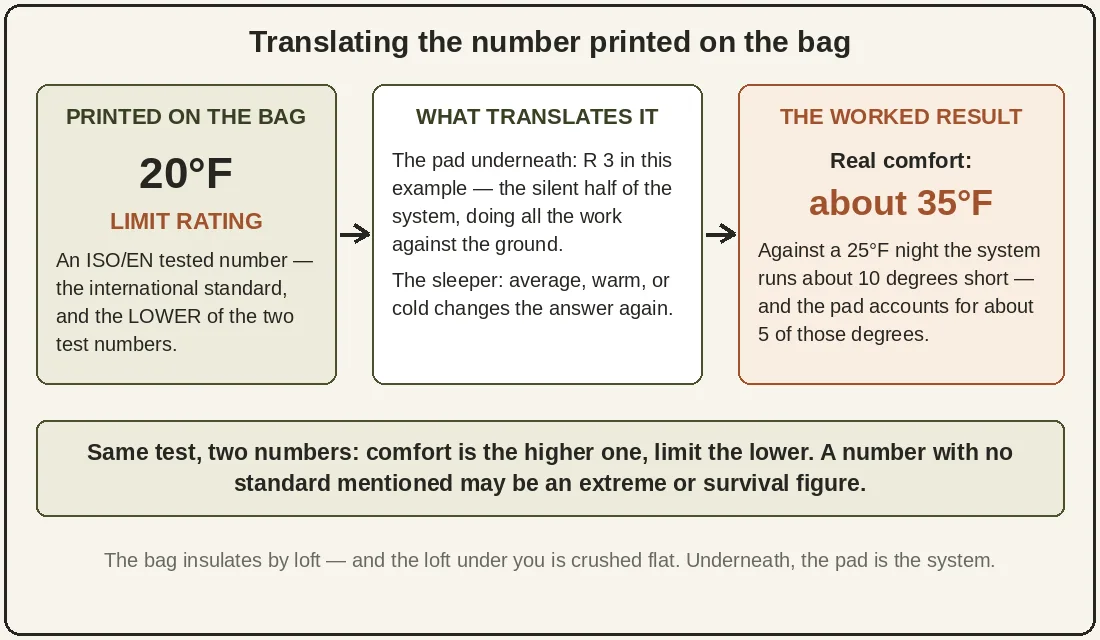
The pad is the silent half of every sleep system. A sleeping bag insulates by loft — trapped air — and the part of the bag under you is crushed flat by your own weight, which leaves the pad doing all the work against the coldest surface in camp: the ground. A summer pad under a winter bag is a winter bag lying on a refrigerator shelf. This is why experienced winter campers talk about their pad’s R-value before they talk about their bag, and why doubling up a foam pad under an inflatable is the oldest cheap trick in cold sleeping.
Worked example: the starting numbers — a bag printed at 20°F with a limit rating, a pad at R 3, an average sleeper, and a 25°F night — come out at real comfort down to about 35°F. Against that 25°F night the system runs about 10 degrees short, and the pad accounts for about 5 of those degrees.
Questions people ask
What is the difference between comfort and limit ratings? Under the ISO test (the old EN standard), a bag gets two honest numbers: comfort, where a typical sleeper stays warm all night, and limit, where a sleeper in a curled position stays alive but not happy. The gap between them is usually 8–12 degrees. Many bags advertise the limit number in the product name. Some advertise a third, unstandardized “extreme” number — the survival floor — which is how a 35-degree bag becomes a “20-degree bag” on a store shelf.
Does a sleeping bag liner really add 10 degrees? Liner makers claim up to 15–25 degrees for their warmest models; independent experience puts a fleece or synthetic liner at more like 5 degrees of real help, a basic one at 2–3. Worth carrying — for the degrees, and because a liner washes easier than a bag — but it will not rescue a system that is 15 degrees short. Nothing worn or added beats rating the system honestly in the first place.
Why did I freeze in a bag rated for the temperature? In the usual order: the rating was a limit or survival number, not comfort; the pad was a summer pad and the ground took the rest; the bag was damp, or compressed from being stored stuffed; or you went to bed cold, hungry, or in the clothes you sweated in all day. The calculator above prices in the first two, because they are the ones printed on the gear.
Building the whole system? The Shelter & Sleep section is where our sleep and shelter comparisons will land — scored on honest comfort numbers, not the ones in the product names.
Hanging instead of lying on the ground? A hammock changes this math — your back is in the air, so the insulation under you is a pad or an underquilt doing the work a bed of leaves does on the ground. It also adds a geometry problem of its own: strap height, suspension length, and hang angle. Our Hammock Hang Calculator works those numbers for your two trees.
Gear that fits this math
No sleep-system comparison on the site yet — it is in the queue. The three pieces buyers cross-shop, one for each variable above:
Kelty Cosmic 20
The honest-bag example: a good, fairly priced down bag whose 20 is an ISO limit rating — exactly the gap this page prices in.
Therm-a-Rest NeoAir XTherm NXT
The pad that takes the ground out of the equation: R-value 7.3 at about a pound.
Sea to Summit Reactor Liner
A few honest degrees, a washable layer between you and the bag, and the cheapest warmth upgrade in the whole system.
As an Amazon Associate, Shelter Tactics earns from qualifying purchases. It never changes a score or a number on this page.