
Two trees are never the distance apart you guessed, and a hammock hung by eye usually proves it at bedtime — too flat, too low, or both. The fix is four numbers: how far apart your anchors are, how long your hammock is, how high you want to sit, and the angle your straps leave the tree. Thirty degrees is the angle every experienced hammock sleeper aims for, because it is where comfort and strap load shake hands. Enter your numbers and this calculator gives you the three that matter: how high to put the straps, how much suspension you need on each side, and how hard each strap is actually pulling.

Run your hang
—
—
—
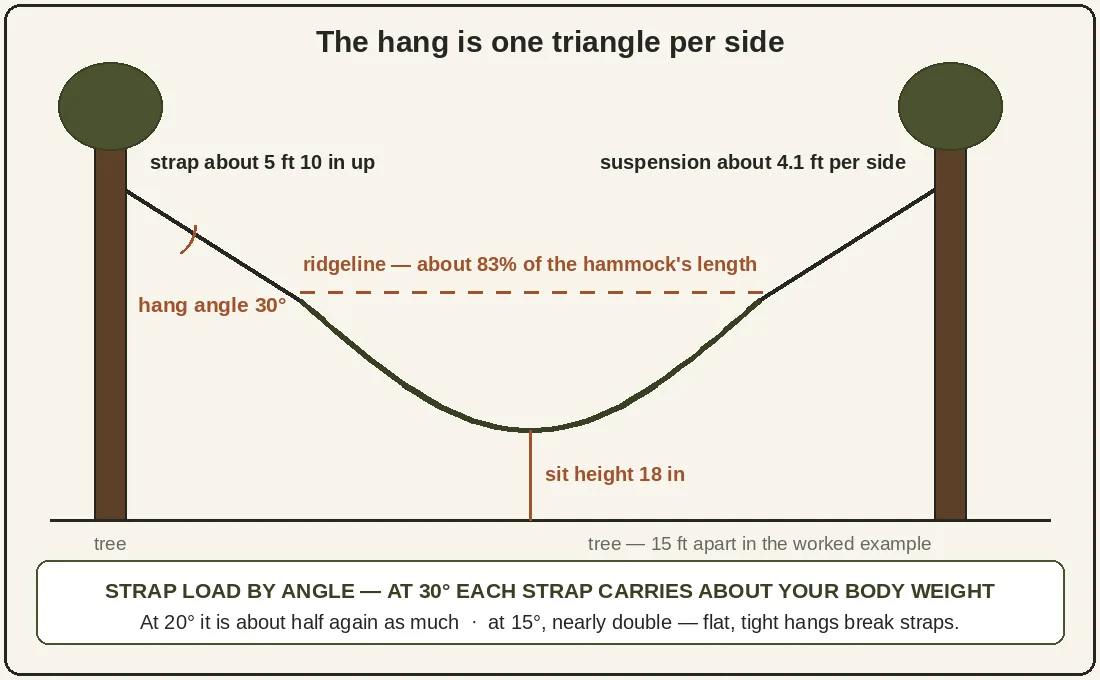
The math underneath is the standard hammock geometry, the same model as Derek Hansen’s widely used Hammock Hang Calculator. A hammock’s ridgeline — the line that sets its sag — runs about 83% of the hammock’s full length. From there it is one triangle per side: the ridgeline end sits above your sit height, the suspension runs from that end up to the strap at your chosen angle, and the load on each strap is half your weight divided by the sine of that angle. That last line is why the angle matters so much. At 30 degrees, each strap carries about your full body weight. At 20 degrees it carries about half again as much. At 15 degrees, nearly double — and it gets worse fast from there, which is why flat, tight hangs break straps, bend hardware, and have pulled down more than a few healthy-looking dead trees.
A worked example
Say your hammock is a common 11-footer, the two trees pace out at 15 feet apart, you weigh 180 pounds, and you want to sit at chair height, 18 inches. The calculator says: put the straps about 5 feet 10 inches up each tree, expect to use about 4.1 feet of suspension per side, and know that each strap is holding roughly 180 pounds of tension with about 156 pounds of sideways pull on each tree. Change one input and watch the trade: stretch the trees to 20 feet apart and the straps climb past 7 feet — higher than most people can reach — which is why wide-spaced trees are a reason to carry longer straps, not a reason to hang flatter.
How to use it
- Measure the gap honestly. Pace the distance between the trees at the height your straps will sit, not at the ground — trunks lean. A pace is roughly 2.5 feet for most adults; two minutes with a tape at home tells you yours.
- Use your real hammock length. It is the full end-to-end figure on the maker’s page, not the fabric alone. If your hammock has a structural ridgeline, its length is already about 83% of that figure, which is what the calculator assumes.
- Set your straps at the height it gives you, then clip in and sit. Your loaded sit height should land within an inch or two of your target; if you are low, raise both straps the same amount rather than tightening one side.
- Check the angle before you commit. A phone inclinometer app or the old thumb-and-fingers estimate both work. If you are under 20 degrees, fix the hang — move the straps up or pick closer trees — instead of trusting the webbing.
Questions people ask
Why does everyone say 30 degrees? Because of the tension math. The shallower the angle, the harder your weight multiplies into strap load: roughly your body weight per strap at 30 degrees, about 1.5 times it at 20, and about twice it at 15. Thirty degrees is also where the lay flattens out for most sleepers. Steeper than 35 or so and the hammock starts to feel tippy and the sit height climbs; shallower and the forces climb faster than the comfort does.
My trees are 20 feet apart. Is that a problem? Not for the hammock — for your reach. A wider gap means longer suspension and higher straps to hold the same angle and sit height, sometimes higher than you can place a strap standing on the ground. The practical fixes are longer tree straps, a step up on a pack or a stump while you hang them, or simply choosing the 13-to-16-foot pair of trees most campsites also have.
Why am I lower in the morning than when I went to sleep? Stretch. Nylon webbing gives a little under load, gathered-end fabric settles, and knots snug down — together worth an inch or three overnight. Set your evening sit height about two inches proud of your target and you will wake up at it.
Can I hang between one tree and my truck? Yes, if the second anchor is genuinely solid — a trailer hitch, a stout roof rack, a steel post set in concrete. Read the sideways pull number the calculator gives you and respect it: that load is constant, all night, and it is more than most fence posts, dead trees, or porch railings should ever be asked to hold. Never hang from a dead tree, whatever the distance.
Do I need a structural ridgeline? Need, no. Want, probably. A ridgeline cut to about 83% of your hammock’s length locks the sag in place, so the lay feels the same every night no matter how far apart the trees are — the suspension absorbs the difference instead of your back doing it. The calculator assumes one. Without one, your hang angle and your sit height trade against each other every single pitch.
One more number a hammock changes: insulation. Your sleeping bag compresses under you and the air takes the heat, so a hammock sleeps colder underneath than a bed on the ground. Before a cold night, run your bag and pad through our Sleep System Temperature Calculator, and read what our Shelter & Sleep section says about under-insulation — it is the half of the hammock system most first hangs get wrong.
Rain goes over the top of it
A hammock is half a shelter until a tarp hangs over it — and the tarp’s ridgeline runs between the same two trees, a foot or two above your straps. The three tarps buyers cross-shop for exactly that job:
Wise Owl Outfitters Rain Tarp
The budget fly: a full kit with stakes and guylines in the bag, sized right over an 11-foot hammock.
Aqua Quest Defender 10×10
The heavy-duty square: more tie-outs than most, pitched as a roof or folded into a dozen other shapes.
Kelty Noah’s Tarp 12
The big canopy: twelve feet of shade and rain cover, enough for the hammock and the gear under it.
As an Amazon Associate, Shelter Tactics earns from qualifying purchases. It never changes a score or a number on this page.