
Last updated: November 1, 2026
Affiliate Disclosure: Shelter Tactics is reader-supported. When you buy through links on this page, we may earn a commission at no extra cost to you. As an Amazon Associate, Shelter Tactics earns from qualifying purchases. Learn more.
The short version: for camping, the brightness you will actually use is 100 lumens or less. Reading in the tent takes 5 to 30 lumens. Cooking and camp chores take about 100. Walking a marked trail takes 100 to 250 that the lamp can hold, not touch for a minute. The 500- and 1,000-lumen numbers on boxes are burst modes for spotting something at distance, and they are measured in a way that flatters them. Buy a headlamp whose middle setting is strong and honest, and the headline number stops mattering.
One note on how this page was built: we don’t stage field tests. The ranges below are where REI’s buying advice, a major headlamp maker’s own guide, and the backcountry guides we checked all land — and then we checked them against the published settings of the four headlamps in our headlamp comparison, because a range that no real lamp’s middle mode matches would be a useless range.
The answer, by job
Every figure below is the setting you would run for the whole job — sustained output, not the burst figure printed largest on the box.
| The job | Lumens you need | Why that much, and no more |
|---|---|---|
| Getting up at night, finding a zipper | 1–10 | Your eyes are adjusted to the dark. More light than this wakes the tent and wipes out the night vision you just spent half an hour building. |
| Reading in the tent | 5–30 | A book is a foot from the lamp. Thirty lumens at that range is plenty; REI’s advice puts plain reading at the bottom of its whole scale. |
| Cooking, chores, cards at the table | 50–100 | Hands, a stove, a knife. This is the setting camp evenings actually run on — the middle mode on most decent headlamps. |
| Walking around camp | 30–100 | Ground you mostly know, at walking pace, with tent ropes and firewood in it. A wide, even beam matters more than the count. |
| Walking a marked trail | 100–250 | You need the next few steps and the next trail marker, held for hours. This is where a lamp earns its keep — or fades and doesn’t. |
| Rough trail, pre-dawn starts, route-finding | 250–400 | Broken ground and choices about where the trail goes next. You are reading terrain, not just footing. |
| Running, or picking a line at distance | 400–600+ | Speed eats distance: at a run you need the ground 30 to 50 feet out, lit well enough to react to. Most campers never need this band. |
| Signaling, searching a field edge | 600–1,000+, in bursts | A burst job, not an evening setting. You light the far bank, find the thing, and come back down to a working level. |
Read the table again and notice where camp life sits: the top five rows, all at 250 lumens or less, and four of them at 100 or less. That is why a lamp’s middle setting decides whether it is a good camp lamp, and why two lamps with wildly different box numbers can feel identical at the picnic table.
What those numbers look like on real headlamps
Here are the four headlamps from our headlamp comparison, with the settings from each maker’s own ANSI FL1 table — the standard test every figure on this page follows. The working setting is the one that does camp; the headline is the one that sells the box.
| Headlamp | Price | Tent / reading setting | Working setting | Headline setting |
|---|---|---|---|---|
| Petzl Tikkina | $19.95 | 7 lm | 100 lm — 10 h on AAAs, plus 20 h reserve | 300 lm — 2.5 h |
| Nitecore NU25 | $53.90 | 1 lm — 160 h; red at 0.9 lm | 38 lm — 8 h; 190 lm high, claimed 5 h | 360 lm — about 30 minutes |
| Petzl Actik Core | $79.99 | 7 lm (red 2 lm) | 100 lm — 7 h on the CORE pack, 10 h on AAAs | 625 lm on CORE — 2 h; 450 lm on AAAs |
| Black Diamond Storm 500-R | $73.88 | 6 lm — 350 h to the test cutoff | 250 lm — 19 h to the test cutoff | 500 lm — 7 h to the test cutoff |
The Petzl Tikkina is the cleanest proof on this page: a $19.95 lamp whose maker prints all three settings plainly, and whose 100-lumen middle covers a whole weekend of camp evenings on the batteries in the box. The Black Diamond Storm 500-R is the strongest working setting here — 250 lumens is a real trail mode, not a chore mode. Full scores and owner feedback for all four are in the comparison.
Prices last checked: October 20, 2026
How many lumens do you need inside a tent?
Inside a tent you need 1 to 30 lumens, and the low end of that range does most of the work. The Nitecore NU25‘s 1-lumen low runs a claimed 160 hours and is enough to find a zipper, a headlamp, or a child’s missing sock without waking anyone. Reading wants a little more — 5 to 30 lumens with the page a foot away. What you want to avoid is the accident every camper knows: clicking straight to a 300-lumen white beam at 2 a.m. A lamp with a genuine low mode, or a red mode like the NU25’s 0.9-lumen red — on a lamp that costs $53.90 as we checked — is worth more inside a tent than another 200 lumens on top.
How many lumens do you need for cooking and camp chores?
Cooking and camp chores need about 100 lumens, and both Petzl lamps in our comparison say so with their mode tables: the Petzl Actik Core and the Petzl Tikkina both put their Standard setting at exactly 100 lumens, and both hold it for a full evening and then some — 7 to 10 hours depending on the battery. That is not a coincidence. A hundred lumens lights hands, a cutting board, and a stove at arm’s length, evenly, without the harsh shadows a tight bright beam throws. If a lamp you are shopping for has no setting near 100 — if it jumps from a dim 20 to a blazing 400 — it will be annoying at the cook table no matter how good its headline number looks. The Tikkina, at $19.95, is the cheapest way we know to buy exactly that 100-lumen setting and nothing you don’t need.
How many lumens do you need to walk a trail at night?
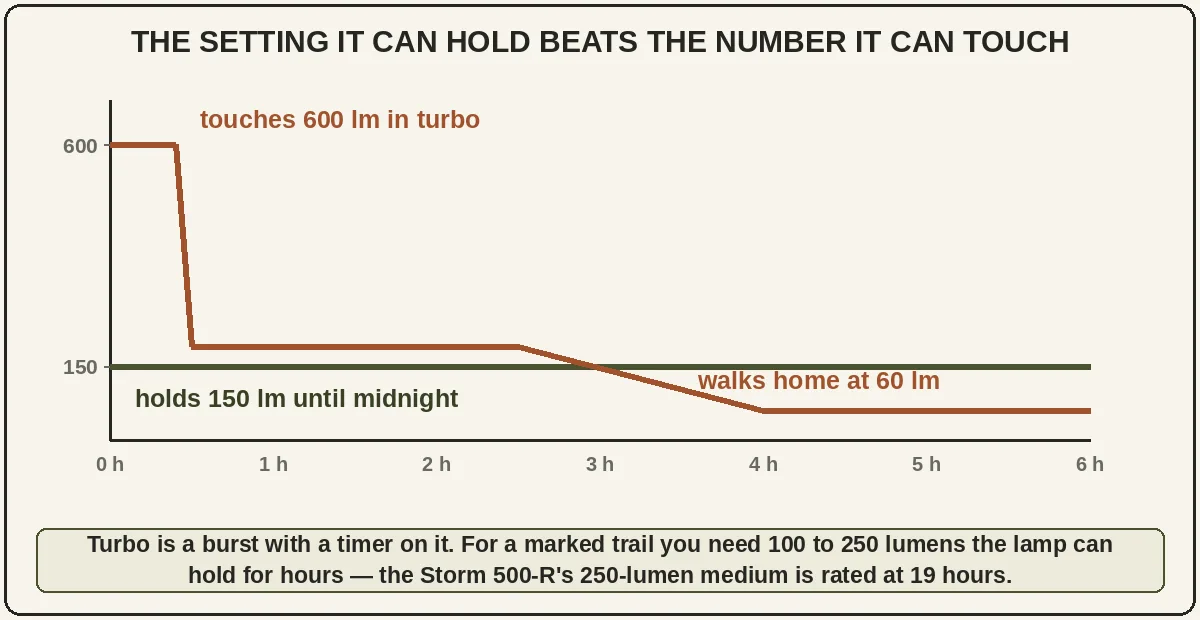
Walking a marked trail at night needs 100 to 250 lumens the lamp can hold for hours, and that second half is the whole answer. The Black Diamond Storm 500-R‘s 250-lumen medium — on a $73.88 lamp, as checked today — is the strongest sustained trail setting among our four lamps, rated at 19 hours — with the honest catch, printed in our comparison, that the Storm is unregulated, so its brightness fades gradually across those hours instead of holding flat. The Nitecore NU25 claims 5 hours at its 190-lumen high, but bench testing found its output dropping steeply well before that, which makes its 38-lumen mid the through-the-night setting. A lamp that holds 150 lumens until midnight beats a lamp that touches 600 and spends the walk home at 60.
When do you actually need 500 lumens or more?
You need 500 lumens or more in bursts, for distance and speed — not as the setting you walk on. The jobs are specific: picking out where a trail crosses a creek before you commit to the bank, checking a field edge or a treeline, moving at a run where the ground 30 feet out has to be readable, and signaling. The Petzl Actik Core‘s 625-lumen top ($79.99 as checked today) is built for exactly those moments, and its own table tells you the cost: Petzl rates that output at 2 hours, while the lamp’s 100-lumen standard does the evening’s real work for 7 hours on the same charge. If your camping never includes route-finding in the dark, a lamp that tops out at 300 honest lumens — the Tikkina — is not underpowered for your life. It is correctly powered, and cheaper for it.
What the burst costs: one lamp, two settings
Petzl Actik Core runtime at each setting, from the maker’s ratings in this section — the 625-lumen burst against the 100-lumen standard, on the same charge.
The burst is for spotting at distance, route-finding and signaling; the standard setting does the evening’s real work.
Why doesn’t a 600-lumen headlamp look twice as bright as a 300?
A 600-lumen headlamp does not look twice as bright as a 300-lumen one because your eyes do not count lumens the way a meter does. Vision follows a power law: as a rule of thumb from the flashlight-testing world, it takes roughly four times the lumens for a light to look twice as bright. Run that backward and it explains two things buyers run into. First, the jump from 300 to 600 lumens — the jump a lot of upgrade money gets spent on — looks like a modest step, not a doubling. Second, the stepdowns in the section above feel smaller in person than on a graph: a lamp that has fallen to a quarter of its starting lumens still looks about half as bright. Neither fact makes the meter numbers useless. It means you should spend on the setting you will live on, where the differences are in hours, not on a top end where the differences are mostly arithmetic.
Do lumens tell you how far a headlamp shines?
No — lumens do not tell you how far a headlamp shines, and our four lamps prove it with their own numbers. The Black Diamond Storm 500-R is rated at 500 lumens and 120 metres of beam. The Petzl Actik Core is rated at 625 lumens and 115 metres. The lamp with fewer lumens reaches farther, because reach is set by candela — how tightly the beam is focused — not by total output. The Tikkina makes the same point from the other end: 300 lumens spread into a wide flood reaches 65 metres, which is short for trail-finding and exactly right for a tent. One more discount to apply before you trust any of these distances: the test standard defines beam distance as the point where the beam fades to 0.25 lux, about the light of a full moon. That is enough to catch a reflective trail marker. For reading the ground itself, plan on about half the printed distance — the same halving our Headlamp Reality Check applies to any lamp you type into it.
What happens to your battery at camping brightness?
At camping brightness, your battery lasts for nights — and that is the trade the box numbers hide. A headlamp battery holds a fixed amount of light: spend it at 500 lumens and it is gone in under two hours; spend it at 100 and the same battery runs the whole weekend. Our Headlamp Reality Check does this arithmetic on the Storm 500-R: the box advertises up to 350 hours, which is true at a glow of a few lumens, and under two hours at its full 500. Both numbers describe the same battery. The practical rule: shop by the runtime at the setting in the table at the top of this page — 100 lumens for chores, 100 to 250 for trails — and treat every runtime printed next to a headline lumen count as marketing until the mode table confirms it.
Honest caveats before you shop by lumens
The runtime test ends at 10%. Under the ANSI FL1 standard, a lamp’s runtime runs until its output falls to 10% of what it made 30 seconds after switch-on. A “7-hour” high mode can be seven hours of steady dimming, and the standard allows it. The number is real; it just doesn’t mean seven hours of the brightness on the box.
The headline number is measured at 30 seconds. FL1 output is read half a minute after the lamp turns on, on a fresh battery, before heat forces the electronics to back off. Turbo modes that hold for 30 seconds and fade over the next two minutes are passing the test honestly and describing your evening poorly.
A lamp with no test standard on the box gives you nothing to check. The four lamps on this page all publish FL1 mode tables, which is why we could build the table above from their own paperwork. Listings that print one big lumen number and no mode table, no beam distance, and no standard are asking you to take the number on faith. On the evidence of every comparison we have run, don’t.
Lanterns play by different geometry. The numbers on this page are for a headlamp’s aimed beam. A lantern spreads its lumens in every direction at once, so it needs more of them for the same job: roughly 100 to 200 lumens inside a tent, 150 to 350 for a campsite table, and 400 or more for a big group site. Comparing a lantern’s 300 to a headlamp’s 300 is comparing a porch light to a flashlight.
Questions readers ask
How many lumens do I need for a camping headlamp?
A camping headlamp needs a working setting of about 100 lumens for chores and 100 to 250 for trails — usually a lamp rated 300 lumens or higher on its box, so its middle modes land in that range. The headline number is a burst mode you will rarely use.
Is 100 lumens enough for camping?
Yes, for most of camping: 100 lumens cooks dinner, sets up a tent, and walks you around a known site — it is the standard working setting on both Petzl lamps we compared. It won’t pick a route across rough ground in the dark; keep a higher mode in reserve.
Is 1,000 lumens too much for camping?
As a headline rating, no — a 1,000-lumen lamp’s lower modes work like any other lamp’s, and the top end serves for distance in bursts. As a setting to run around camp, yes: it blinds everyone facing you and drains a battery in an hour or two.
How many lumens should a camping lantern be?
A camping lantern should be 150 to 350 lumens for a normal site — enough for a table of people to cook and eat by. Inside a tent, 100 to 200 is plenty, and 50 makes a good night-light. Big group sites want 400 or more, or two smaller lanterns.
Do more lumens mean a headlamp shines farther?
No. Distance comes from candela — how focused the beam is — not total lumens. Our comparison’s 500-lumen Storm 500-R is rated to 120 metres, the 625-lumen Actik Core to 115, and a 300-lumen flood lamp to only 65. Check the beam-distance line, then halve it for reading detail.
Why does my headlamp get dimmer after a few minutes?
Because it is protecting itself. Bright modes make heat the small body can’t shed, so the electronics step output down — sometimes within two minutes of a turbo starting. Unregulated lamps also fade as the battery drains. Both are normal; pay for a lamp that holds its working setting flat.
Why does my headlamp get dim a few minutes after I turn on turbo?
Your headlamp gets dim a few minutes after turbo because turbo is a burst with a timer on it, not a setting the lamp can hold. On the Nitecore NU25 in our comparison, Nitecore’s own manual gives the 360-lumen turbo exactly 30 seconds before it steps down to the 190-lumen high “to prevent overheating” — and says that if the lamp is still hot, it stays at the lower level even if you switch turbo back on. The LED and its driver make more heat at full power than a body the size of a matchbox can shed, so the electronics cut output — on a timer, a temperature sensor, or both — before the heat cooks the LED or the battery. The box will never tell you this: the ANSI FL1 test reads a lamp’s output 30 seconds after switch-on, on a fresh battery, and the NU25’s printed 30-minute turbo runtime carries the manual’s own footnote — it is “the testing result before starting temperature regulation.”
The shape of the dimming tells you which thing you are seeing. A step down is a visible drop at about the same point every time, on a fresh battery as readily as a tired one — that is the limiter doing its job, not a failing lamp. A slow fade across the evening is the other mechanism: an unregulated lamp like the Black Diamond Storm 500-R dims gradually as its battery drains, with no step in it. Work with the limiter instead of against it. Run the setting under turbo for anything longer than a look — the Petzl Actik Core’s 100-lumen standard holds 7 hours on its CORE pack, while its 625-lumen top is for picking out the creek crossing, not walking by — and save turbo for bursts of seconds. Cold night air buys a turbo a little longer, because the body sheds heat faster; clicking it back on every minute buys nothing but a hotter lamp.
Keep reading
This page is part of our Lights hub, where the claimed-vs-tested output dataset grows with every comparison. When you are ready to pick the lamp itself, Headlamps Compared scores four of them on specs, price, and owner feedback, and the hunting headlamp guide covers the red and green modes this page only touched. And before you spend on any lamp not covered here, run its box numbers through the Headlamp Reality Check — it translates the lumens, the hours, and the beam distance into what the battery can actually do.
Talk it over with other readers. The Shelter Tactics Community on Facebook is where readers compare notes on knives, lights, packs, and the rest of the kit — and where your questions help decide what we research next. Join the group →
Three more worth a look
Not in the comparison above — three more headlamps readers cross-shop against these four. We have not reviewed or scored these; they complete the field.
Fenix HM65R
The metal-bodied step up: spot and flood beams in one housing, from the same maker as the top pick on our hunting page.
Nitecore NU43
The NU25’s bigger sibling: more output and a bigger battery, for people who found the NU25’s ultralight trade-offs too tight.
BioLite HeadLamp 330
The comfort pick: a slim, flush-fitting lamp built to be worn for hours. Stock comes and goes on Amazon — worth a check when you shop.
As an Amazon Associate, Shelter Tactics earns from qualifying purchases. Mentioned products are not reviewed or scored by us.