Packs & Bags — Comparison
Best Bug-Out Bags Compared: 4 Picks on Specs, Price & Owner Feedback
The best bug-out bag for most people is the 5.11 RUSH24 2.0 — 37 liters is the size a three-day load actually wants, and it is built well enough to stop thinking about. Need real 72-hour room? The RUSH72 2.0 steps up to 55 liters; the REEBOW GEAR 3-Day is the budget way in.
How we researched this comparison: We scored 4 products on evidence (30), cost of ownership (25), owner experience (25) and preparedness fit (20), using makers’ published specifications and patterns in verified owners’ reports. Prices on this page were last checked October 20, 2026. How We Rate.
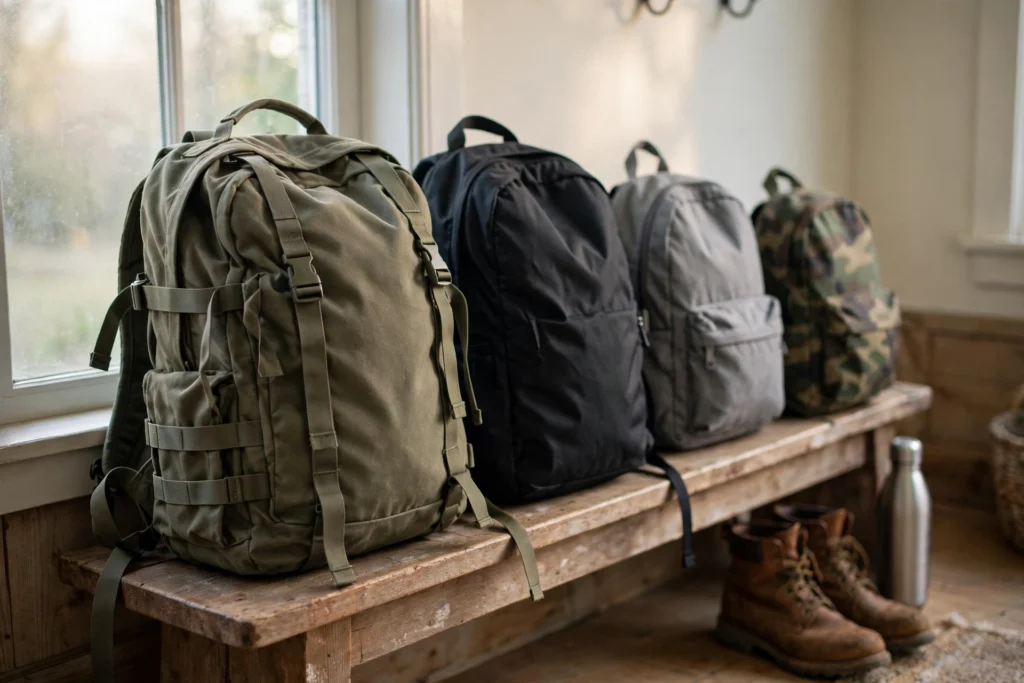
5.11 RUSH24 2.0
Score out of 100
5.11 RUSH72 2.0
Score out of 100
Eberlestock Switchblade
Score out of 100
REEBOW GEAR 3-Day
Score out of 100
Buying through the links above may earn us a commission at no extra cost to you — and a commission never changes a score. How that works.
The four bags, side by side
| Pack | Price | Capacity | Empty weight | Dimensions | Material | Hip belt | Warranty |
|---|---|---|---|---|---|---|---|
| 5.11 RUSH24 2.0 Read the review ↓ |
$140.00 | 37 L (2,275 cu in) | 3.84 lb | 20 × 12.5 × 8 in | 1000D/1050D nylon* | None included (add-on kit) | Defects — as long as you own it |
| 5.11 RUSH72 2.0 Read the review ↓ |
$190.00 | 55 L (3,342 cu in) | 5.3 lb | 23 × 13.5 × 8.5 in | 1050D nylon (1000D MultiCam) | Cinching waist strap | Defects — as long as you own it |
| Eberlestock Switchblade Read the review ↓ |
$244.55 | 29.3 L (1,785 cu in) | 3.6 lb | 20.5 × 12 × 8 in | 500D nylon / ripstop† | Compatible, not included | Lifetime — defects |
| REEBOW GEAR 3-Day Read the review ↓ |
$29.99 | 40 L (claimed) | 2.82 lb‡ | 20 × 13 × 11 in | “High density fabric” — denier not published | Webbing waist strap | None published |
Prices last checked: October 20, 2026
* 5.11’s own listings put the RUSH24 2.0’s fabric at 1000D in some colorways and 1050D in others; the build quality owners report does not split along that line.
† Eberlestock does not headline a single fabric for the Switchblade; retailer spec sheets list 500D nylon with ripstop panels.
‡ Empty weights are the dataset this hub tracks, because listings disagree. 5.11 publishes 3.84 lb for the RUSH24 2.0 while a current Woot listing prints 4.2 lb (on a page that mixes in first-generation specs). The RUSH72’s maker figure is 2.4 kg — 5.3 lb — against 5.5 lb in the same Woot listing. REEBOW’s 2.82 lb comes from its Amazon listing copy; reseller write-ups of the same bag have printed 1.8 lb and 5.2 lb. Eberlestock’s spec table says 3.60 lb for the Switchblade while its own FAQ on the same page rounds it to “just under 3.5 lb.” We print the maker’s spec-sheet figure in every case and flag the spread, here and on the hub.
5.11 RUSH24 2.0 — 87/100 (8.7/10)
Who it’s for: the one-bag buyer. At 37 liters the RUSH24 2.0 holds a genuine three-day load — food, water, shelter layer, tools — without the empty space that tempts you to pack a fourth day you can’t carry. It is $140.00 at the price checked above, and it doubles as a travel and everyday pack better than anything else here: the main compartment is 20 × 12.5 × 8 inches, carry-on size for most airlines, with a padded sleeve that takes a 15-inch laptop.
What owners praise: that it does not wear out. Multi-year daily-use reports are the norm for this pack, not the highlight reel — zippers and stitching still working after years of commuting, range trips, and ATV racks. The organization is the other constant: an admin front pocket, a fleece-lined eyewear pocket, dual top pockets, mesh pockets inside the main compartment, and a hidden CCW compartment. Owners who live out of the bag for work trips say the layout is the reason they keep it. The Black listing linked below sits at 4.8 stars across 466 ratings — a smaller pool than the REEBOW’s, and a happier one.
Where they complain: weight and the missing belt. The pack itself is 3.84 lb empty — before a single item goes in, it has spent more of your carry budget than the whole REEBOW weighs. And there is no waist belt in the box: loaded past about 25 pounds, everything rides on your shoulders unless you buy 5.11’s add-on belt kit. Two smaller knocks recur: it reads unmistakably tactical (a gray RUSH24 is still a RUSH24), and it has so many pockets that one long-term reviewer has twice lost a multitool to airport security because he forgot which pocket it was in.
Buy it if you want one bag for the bug-out closet, the truck, and the occasional flight, and your three-day load stays near 25 pounds. Skip it if you need a real hip belt today, or you want to walk past people unnoticed. 1000D/1050D water-repellant nylon, YKK zippers, contoured yoke shoulder straps, rear hydration compartment for a 2-liter bladder. Our link goes to the Black version; the other colors are the same bag. Check the price on Amazon
5.11 RUSH72 2.0 — 83/100 (8.3/10)
Who it’s for: the carrier whose three-day load is genuinely big — bulky shelter, cold-weather layers, food for a second person part of the way — and who would rather have room left over than a zipper straining shut. The RUSH72 2.0 is 55 liters (3,342 cu in), $190.00 at the price checked above, and it is the only bag here with a reinforced back panel and an aluminum stay to push back against a heavy load.
What owners praise: capacity that survives contact with real life. Search-and-rescue and military users dominate the long-term reports — one SAR operator carried his through four hurricane deployments — and the through-line is that the bag holds a full 72-hour kit, organized, without anything strapped hopefully to the outside. The Shove-It compartment between the front pocket and the main bag earns its own praise for jackets and odd-shaped gear. The Kangaroo listing linked below rates 4.6 stars across 153 reviews — color variants split their review pools on Amazon, so read that as a sample, not the whole story.
Where they complain: the bag makes its own problem. At 5.3 lb empty it starts heavy, the 55 liters invite filling, and owners say the same sentence different ways: a full RUSH72 gets overweight fast, which is why more than one of them keeps it in a vehicle instead of on a closet hook. The waist strap is a cinching strap, not a load-bearing belt — owners comparing it to hiking packs call it flimsy — the back panel doesn’t breathe, and the main zipper can snag when the bag is stuffed past sensible. Owners of the first generation also miss the front magazine pockets the 2.0 dropped.
Buy it if your load list is written down, weighs what it weighs, and doesn’t fit 37 liters. Skip it if you’re buying room “just in case” — case-filling is how a bug-out bag becomes a storage bin with straps. 1050D water-repellant nylon (1000D in MultiCam), 3-liter hydration compartment, side pockets, Tier System compatible. Our link goes to the Kangaroo colorway. Check the price on Amazon
Eberlestock Switchblade — 80/100 (8.0/10)
Who it’s for: the person whose emergency bag has to live in normal life — an office, a truck cab, a train — without announcing itself. The Switchblade is 29.3 liters (1,785 cu in) in a clean 20.5 × 12 × 8 inch profile with almost no external webbing, and at $244.55 it is the most expensive bag here by a wide margin. What the money buys is build and backing: Eberlestock’s lifetime warranty against defects, and a divider that swallows a 17-inch laptop.
What owners praise: years of nothing going wrong. The longest owner report we found is also the simplest: a gear reviewer who has carried a Switchblade since 2018 — every flight, daily commuting, events — with zero failures, and who does the math as about $30 a year and falling. Eberlestock’s own store rates it 4.85 out of 5 across 1,369 reviews. The magnetic CCW pocket, reachable from either side with a padded back panel you can’t feel the contents through, is the feature owners name most after durability.
Where they complain: the price, and what isn’t in the box. There is no hip belt included — the harness accepts one, sold separately — so past day-pack loads your shoulders carry everything, and the same long-term reviewers who love it say plainly they wouldn’t pick it for multiday hiking without adding that belt. At 29.3 liters it is also the smallest bag here: a solo three-day load fits only if your shelter and sleep gear are compact. The top lid pocket is big enough that small items get lost in it.
Buy it if your real scenario is get-home or vehicle-based, your kit is compact, and you’d rather buy once. Skip it if you need three full days of bulky gear in the bag, or the budget has to cover the gear that goes inside too. Adjustable ladder harness, MOLLE-10 webbing, Nalgene-sized bottle pockets, hydration sleeves. Our link goes to the Dry Earth colorway. Check the price on Amazon
REEBOW GEAR 3-Day Assault Pack — 78/100 (7.8/10)
Who it’s for: the first bag, the second bag, the bag for the teenager’s closet and the trunk of the second car. The REEBOW claims 40 liters — more than the RUSH24 on paper — and costs $29.99 at the price checked above, the least money in this comparison by a factor of four. It has been Amazon’s best-selling tactical pack, with a 4.7-star average across a review count in the tens of thousands (24,748 ratings on the listing checked today).
What owners praise: space per dollar, full stop. Two large compartments, two front pockets, MOLLE webbing on the front and sides, compression straps, a ventilated mesh back panel — owners use it as a school bag, a range bag, a truck bag, and a three-day camping bag, and the praise pattern is that it simply holds everything they throw at it for the price of a pizza night. For a kit that mostly sits ready, that math is hard to argue with.
Where they complain: the failures are structural, and they cluster. The top critical review on a current retail listing describes a three-inch rip opening along a main-compartment seam after months of daily use — not abuse, just use. Shoulder straps work themselves loose because the webbing has no folded stop, and owners sew their own fix. GearJunkie’s testers found the bag gets unruly past about 25 pounds: no frame, a webbing waist strap, and 40 claimed liters it can’t comfortably carry full. Straps also run short on larger frames, the side pockets won’t take big bottles, and REEBOW publishes no fabric denier and no warranty we could find — the spec sheet is the thinnest here, which is part of why this bag’s evidence score is the lowest of the four.
Buy it if the alternative is no bag yet, or you’re outfitting several kits at once and will keep loads light. Skip it if it’s your only bag and you plan to walk miles under 30 pounds — that’s the load its seams and straps complain about. Hydration compatible (bladder not included), double-stitched seams, cord-pull zippers. Our link goes to the Tan version. Check the price on Amazon
How many liters do you actually need for three days?
For one adult, a three-day load needs roughly 35–45 liters once food and water are in it — which makes the RUSH24 2.0’s 37 liters the honest center of this group, not the small option. Water alone is about a liter a day minimum, food runs 2–4 liters of space, a change of clothes 5–10, and shelter and tools fill most of the rest. The Switchblade’s 29.3 liters works when shelter is a tarp and the sleep kit is compact. The RUSH72’s 55 liters is for bulky gear or carrying for two. The REEBOW’s claimed 40 liters passes the size test and fails the carry test first — volume was never its problem. Our Bug-Out Bag Weight Checker turns your own load list into the number that decides this: total weight, and what share of your body weight it is.
Which of these bags carries a heavy load best?
The RUSH72 2.0 carries a heavy load best — it is the only bag here with an aluminum stay in a reinforced back panel, and owners have carried 30–50 pounds in it for years. But “best” is relative: its waist strap is a cinching strap, and hiking-pack owners find it flimsy next to a real padded hip belt. The RUSH24 and the Switchblade have no belt in the box at all, and the REEBOW gets unruly past about 25 pounds in tester reports. The plain rule the owner reports support: under 25 pounds, any of these works; past 30, only the RUSH72 is even pretending, and a framed hiking pack beats all four.
How much does each bag weigh before you put anything in it?
The REEBOW GEAR 3-Day is the lightest empty bag here at a listed 2.82 lb — and the least certain figure, since reseller write-ups of the same bag print 1.8 lb and 5.2 lb. The Switchblade is 3.6 lb by Eberlestock’s spec table (its own FAQ says “just under 3.5”), the RUSH24 2.0 is 3.84 lb by 5.11’s sheet against 4.2 lb in a current retail listing, and the RUSH72 2.0 is 5.3 lb. Empty weight is not trivia: in a 25-pound total load, the RUSH72 has spent more than a fifth of it before food or water goes in. This claimed-vs-listed spread is exactly what our Packs & Bags hub now tracks for every pack we compare.
Will any of these bags keep your gear dry in real rain?
No — none of the four is waterproof, and every maker here is honest about it if you read past the headline. All four use water-repellant fabric: fine in a shower, seeping at the seams and zippers in a sustained storm. The fix is the same for all of them and costs little: a pack liner or dry bags inside for the things that must stay dry, and a rain cover outside if you’ll walk in weather — Eberlestock sells one sized for the Switchblade, and neither 5.11 bag includes one. Plan on the liner; treat the coating as a head start, not a solution.
Which bag disappears in a crowd, and which one announces itself?
The Eberlestock Switchblade disappears — clean face, minimal webbing, colors that read as a commuter pack — and that is a deliberate part of its design, down to the concealed-carry pocket you can’t see. Both 5.11 bags announce themselves: MOLLE webbing, name-tape panels, and a silhouette anyone who has seen tactical gear recognizes, the RUSH72 loudest by sheer size. The REEBOW sits with the 5.11s — full MOLLE and military styling at a budget price. Whether announcing matters depends on your route out; for a vehicle kit it matters not at all, and for a walk through a city it might matter most of all.
What does each bag cost to own, not just to buy?
The REEBOW GEAR 3-Day is cheapest to buy at $29.99 and the likeliest to be replaced — its seam and strap complaints are wear-out failures, and there is no published warranty behind it. The RUSH24 2.0 at $140.00 adds a possible belt kit to the bill; the RUSH72 2.0 at $190.00 needs nothing but tempts you to fill 55 liters. The Switchblade at $244.55 costs the most up front, then asks for a hip belt only if you load it like a hiking pack — and its lifetime warranty plus eight-year owner reports make its cost per year the easiest to defend. 5.11’s warranty covers defects for as long as you own the bag; Eberlestock’s is lifetime against defects. Neither covers wearing a bag out — no honest warranty does.
The honest caveats
Liters are the softest number on any spec sheet. There is no enforced standard for pack volume. REEBOW’s 40-liter claim sits inside a 13 × 20 × 11 inch box that measures about 47 liters on the outside, so the claim is plausible — but the same listing never says what the fabric is, and a maker that won’t publish a denier hasn’t earned the benefit of the doubt on volume either. 5.11 and Eberlestock publish cubic inches alongside liters (2,275 and 3,342; 1,785), and the two figures agree with each other, which is what a verifiable claim looks like.
“Military” and “tactical” are styling words, not specifications. None of these four bags is issued gear. What separates them is published fabric, published weight, a warranty with a name behind it, and owner reports at scale — all four are compared on those, not on how the product photos look in a field.
Every bag here is water-repellant, not waterproof, every hydration claim means “compatible” (no bladder is included with any of them), and every capacity figure assumes you pack like you mean it. A bag’s MOLLE webbing also adds weight and snag, and most owners attach far less to it than the product photos suggest.
Which of these bags should you buy?
- Best for most people: 5.11 RUSH24 2.0 (87/100). The right size, the deepest owner record, and a build that stops being a worry. Budget for the belt kit if your load creeps past 25 pounds.
- Most room: 5.11 RUSH72 2.0 (83/100). A true 72-hour bag with a stay — if your written load list actually needs 55 liters.
- Best budget: REEBOW GEAR 3-Day (78/100). The starter bag and the spare-kit bag. Keep the load light and check the seams when you rotate the kit.
- Best low-profile: Eberlestock Switchblade (80/100). The get-home and vehicle pick that looks like nothing at all, with the warranty to outlast the plan.
Questions readers ask
How many liters should a bug out bag be?
For one adult carrying three days of food, water, shelter, and tools, 40–50 liters is the range most sizing guides land on, and 37 liters works if your gear is compact. Below 30 liters means leaving something behind; above 55, the bag fills with weight you then have to carry.
How heavy should a loaded bug out bag be?
Keep the total under about a fifth of your body weight, and closer to a tenth if you can — and under roughly 25 pounds is where these four packs stay comfortable. Water and food decide most of it: two liters of water alone is 4.6 pounds before the bottle. Weigh the bag packed, not by feel.
Is the RUSH24 big enough for three days?
Yes, for one person with a compact sleep kit — 37 liters holds three days of food, water carried partly in the hydration compartment, a tarp or small tent, and tools. It gets tight with a bulky sleeping bag or cold-weather layers; that’s the honest line where the RUSH72’s 55 liters starts earning its weight.
Does the RUSH24 come with a hip belt?
No. The RUSH24 2.0 ships with shoulder straps and a sternum strap only; 5.11 sells a belt kit that attaches to it. Owners carrying under about 25 pounds rarely miss it. Owners carrying more name its absence as the pack’s main comfort limit, which is why our review scores it the way we do.
RUSH24 or RUSH72 — which one should I buy?
Buy the RUSH24 if your load is one person’s three days and you value a bag that also works for travel and daily use. Buy the RUSH72 if your load list — written down and weighed — doesn’t fit 37 liters, or you carry shelter and food for a second person. Empty space gets filled; buy the smaller bag your list allows.
Can I use a normal backpack as a bug out bag?
Yes — the bag matters less than the load list and the total weight. What a purpose-bought pack adds is tougher fabric, better zippers, compression straps, and organization that survives being grabbed at 3 a.m. If your current pack carries your weighed kit comfortably for a mile, it has passed the only test that counts.
Tactical MOLLE pack or a regular hiking backpack for a bug-out bag?
For a bug-out bag you may actually have to walk somewhere in, choose the regular hiking backpack; for a bag that rides in a vehicle and gets grabbed, opened, and lived out of at short range, the tactical MOLLE pack earns its place. The split is carry against access. A hiking pack is built to carry: an internal frame and a padded hip belt fitted to your torso length, and REI’s fitting guidance puts 80 percent or more of a loaded pack’s weight on your hips, where your legs can take it for miles. None of the four packs in this comparison ships with that belt — the RUSH24 2.0 and the Switchblade include none at all, and the RUSH72 2.0 and the REEBOW make do with straps — which is why owners of all four feel the load on their shoulders past about 25 pounds.
What MOLLE buys instead is order and reach: webbing rows for pouches where you want them, an admin pocket that keeps small gear findable in the dark, and fabric that shrugs off truck beds and gravel. The costs are in our table. The webbing and 1000D-class cloth are weight spent before anything goes in — 3.84 lb empty for the RUSH24’s 37 liters, 5.3 lb for the RUSH72 — pouches hung on the outside pull the load away from your back and snag, and, as the crowd section above shows, the webbing announces the bag. So the rule is distance and weight, not looks. Past a few miles on foot, or past roughly 25 pounds all-in, take the hiking pack in the 45-to-55-liter range and put everything inside it. If the bag’s honest job is the truck, the closet by the door, and a short walk home, take the tactical pack’s organization — the RUSH24 is this comparison’s top score at 87/100 for exactly that life — and if you already own one and your route is short, spend the next money on what goes inside it, not on a second bag.
Once you’ve picked the bag, run your load through our Bug-Out Bag Weight Checker — tick what’s actually in it and see the total and its share of your body weight. And the blade that rides in nearly every kit is its own decision: our fixed-blade knives compared guide scores six of them on the same card.
Keep reading
This guide is the anchor for our Packs & Bags hub, where the claimed-vs-actual weight dataset lives and where the next pack comparisons will land — including the follow-up this guide sets up — what size backpack you need for three days, answered with a liters-by-days table. If you want to know how the scores above were built, How We Rate shows the whole scorecard.
Prices last checked: October 20, 2026. Prices and availability change; the prices shown were the Amazon prices on the morning this comparison was prepared.
Talk it over with other readers. The Shelter Tactics Community on Facebook is where readers compare notes on knives, lights, packs, and the rest of the kit — and where your questions help decide what we research next. Join the group →