Fire & Cooking — Comparison
Ferro Rods Compared: 3 Picks on Specs, Price & Owner Feedback — Plus How to Use One
Buy the bayite 4-inch ferro rod kit if you want the most fire for the least money — a thick rod and the best striker in this group. Buy the überleben Zünden if your hands are the problem: its hardwood handle and soft-sparking rod are the forgiving option with cold or gloved hands.
How we researched this comparison: We scored 3 products on evidence (30), cost of ownership (25), owner experience (25) and preparedness fit (20), using makers’ published specifications and patterns in verified owners’ reports. Prices on this page were last checked October 22, 2026. How We Rate.
bayite 4″ Ferro Rod Kit
Score out of 100
überleben Zünden
Score out of 100
Swiss Safe 5-in-1 (2-Pack)
Score out of 100
Buying through the links above may earn us a commission at no extra cost to you — and a commission never changes a score. How that works.
The three rods, side by side
| Ferro rod | Price | Rod size | Claimed strikes* | Striker | Handle / grip | Weight | In the box |
|---|---|---|---|---|---|---|---|
| bayite 4″ Ferro Rod Kit Read the review ↓ |
$13.95 | 4″ × 3/8″ | 12,000+ | HSS steel Striker-Pro, 6 striking edges | None — 5 ft paracord lanyard wraps as the grip | 2.35 oz | Rod, striker, paracord |
| überleben Zünden Read the review ↓ |
$18.00 | 3/8″ thick (length ~2.75″ of rod) | 15,000 | 6-function multi-tool striker | Handcrafted hardwood handle | ~3.1 oz | Rod, striker, 550 paracord lanyard |
| Swiss Safe 5-in-1 (2-Pack) Read the review ↓ |
— | ~2.2″ rod in a 5″ tool | 16,000 per starter | Steel scraper with saw-tooth edge | Plastic tool body — compass in the handle cap | Under 2 oz each | Two starters, each with compass, whistle, scraper, paracord |
* Claimed strikes are the makers’ numbers. No standard test exists for them, and no maker in this group publishes how theirs was counted — treat the strike column as a rough size guide, not a measurement. Diameter and length are the honest lifespan numbers: a rod is used up by the metal you scrape off it, so more metal means more fires. All three makers claim sparks at 5,500°F (3,000°C), the standard ferrocerium figure.
Prices last checked: October 22, 2026
bayite 4″ Ferro Rod Kit — 88/100 (8.8/10)
Who it’s for: almost everybody, and especially anybody stocking more than one kit. The bayite kit at $13.95 is a 4-inch rod a full 3/8 inch thick — 4.7 stars across 12,796 ratings when we checked — with a drilled hole, five feet of paracord, and the Striker-Pro, a tool-grade high-speed steel striker with six crisp edges. There is no handle and no gimmick. That plainness is the product.
What owners praise: the striker, first, and the spark it pulls. In Outdoor Life’s ferro rod testing the bayite’s scraper was the best of the group — “exceedingly good edges” — and its sparks flew as far and lasted as long as the expensive rods’. Owners repeat the same two reports: it throws a big shower once the coating is off, and it keeps doing it for years of campfires.
Where they complain: grip and finding it again. With no handle, the rod is a paracord wrap in your fist — workable, but the least secure hold here with gloves or cold hands. The black and olive finishes also vanish in leaf litter when dropped; more than a few owners add bright tape or swap the cord for orange. At 2.35 oz it is not the lightest rod for its size, either.
Buy it if you want one rod per bag at a price that makes that possible. Skip it if grip is your weak point — cold hands and gloves are the Zünden’s whole argument. Check the price on Amazon
überleben Zünden — 85/100 (8.5/10)
Who it’s for: the person whose fire-starting fails at the scrape, not the tinder. The Zünden is built around überleben’s Sånft-korr blend — a softer ferrocerium — set in a handcrafted hardwood handle, with a six-function multi-tool striker on a mil-spec 550 paracord lanyard. The listing shows 4.7 stars. The listing sells three thicknesses: the Trad at 5/16″ (12,000 claimed strikes), the Pro at 3/8″ (15,000), and the Fatty at 1/2″ (20,000). Our score is for the line as a whole, and the Pro is the one we would buy — the middle thickness is the sweet spot of grip, sparks, and life. One shopping warning: the listing showed $18.00 when we checked, and the price moves with the thickness selected, so confirm which variant is in your cart before you pay.
What owners praise: how easy the sparks come. The soft blend sheds metal readily, so a deliberate scrape throws a heavy shower that hangs a moment — forgiving when your tinder is less than perfect. The wood handle gets the other half of the praise: a full grip that stays in the hand with gloves on, where most rods are a two-finger pinch. The striker earns its own fans — one long-running review account uses it on his other rods because it throws a better shower than theirs did.
Where they complain: the trade inside the softness. A rod that sheds metal easily sheds it away — owners who practice weekly report visible wear sooner than on harder rods. It is a lifespan measured in years either way, but the Zünden spends its metal faster to buy those easy sparks. It is also the priciest rod here for the least rod length.
Buy it if you are learning, or your hands are cold, gloved, or not strong. Skip it if you want maximum strikes per dollar — that is the bayite, twice over. Check the price on Amazon
Swiss Safe 5-in-1 Fire Starter (2-Pack) — 77/100 (7.7/10)
Who it’s for: stocking up. One box holds two complete starters, so a car kit and a pack kit get covered in one purchase, and each tool carries a built-in compass, a 150 dB whistle, a steel scraper, and 450 lb paracord around its rod. The family listing shows 4.6 stars across 12,268 ratings. One availability note: when we checked on October 22, 2026, neither Keepa nor camelcamelcamel showed a live price for this two-pack, so this page prints none for it — the link still goes to the listing, and the price may be back when you look. As a way to put something that sparks in every bag a family owns, nothing else here competes.
What owners praise: the count and the extras that do work. Two starters that light fires in any weather, a whistle that is genuinely loud, and a tool small enough — 5 inches, under 2 ounces — that it actually stays in the kit instead of being left home for size. For glove-box and kids’-pack duty, owners rate it well.
Where they complain: size and the extras that don’t. The handle is too small for large hands and the smooth body can be slippery to hold while striking — the opposite end of the grip scale from the Zünden. The whistle draws “poor quality” notes in roundup after roundup, and the button compass is a rough-direction toy, not a navigation tool: fine for “which way is north, roughly,” not for a bearing. One more honesty note: Swiss Safe calls this a “magnesium ferro rod,” and its own instructions tell you to shave the rod itself for tinder shavings. There is no separate magnesium block in the box, the way a true magnesium-bar kit has — the shavings come off the same rod you need for striking.
Buy it if several kits need a starter each and the budget is one box. Skip it if it will be your one primary rod — buy the bayite and a separate whistle instead. Check the price on Amazon
How to use a ferro rod — the half of this page that lights the fire
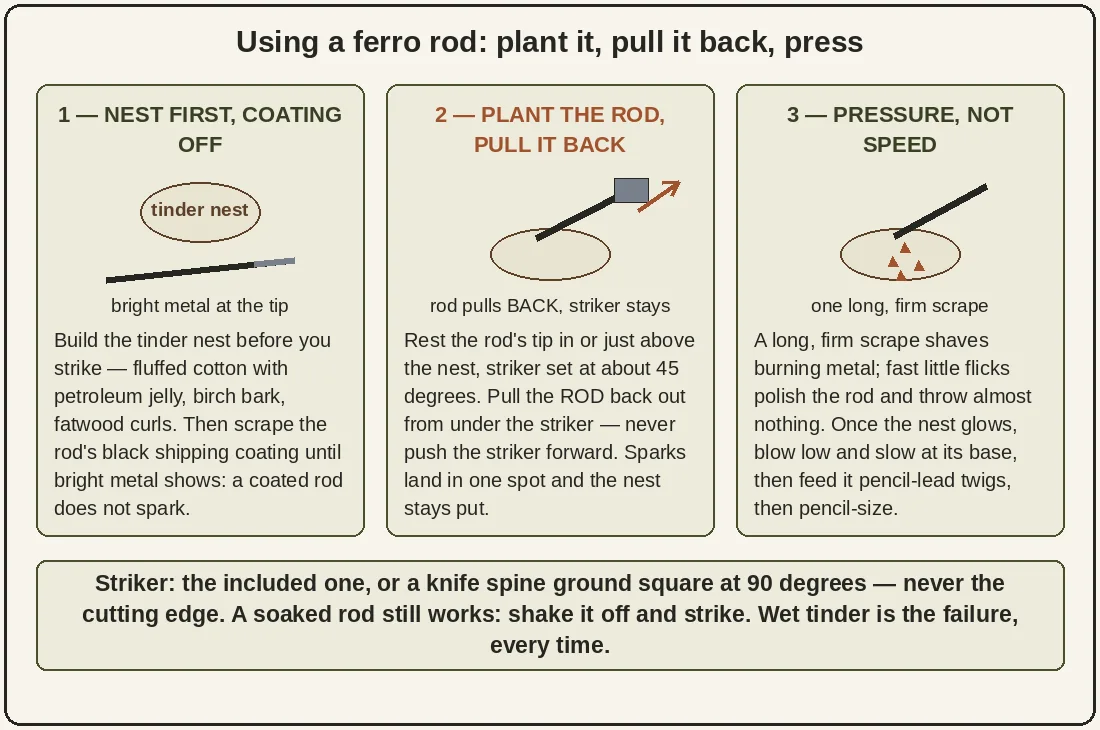
A ferro rod is the most reliable fire starter ever sold and the one beginners fail with most, because the rod is only half the system. Do these steps in this order:
- Build the tinder nest first. Sparks are brief and hot; they need fine, dry material waiting — a fluffed cotton ball with petroleum jelly, shredded birch bark, fatwood curls, or a feather stick’s fine shavings. If the nest isn’t ready before you strike, you are wasting strikes warming up your technique.
- Scrape the black coating off a new rod. Rods ship with a protective coating, and it does not spark. A few firm scrapes until bright metal shows is the whole fix — and the reason behind most “my ferro rod doesn’t work” reviews of every brand above.
- Plant the rod, pull the rod back. Rest the rod’s tip in or just above the nest, set the striker against it at about 45 degrees, and pull the rod back out from under the striker instead of pushing the striker forward. The sparks land in one spot — the nest — instead of scattering, and the nest stays put.
- Use pressure, not speed. A long, firm scrape shaves burning metal. Fast little flicks polish the rod and throw almost nothing. If the shower is thin, slow down and press harder before you blame the rod.
- Blow low and slow once it catches. A glowing nest wants gentle air at its base, then pencil-lead twigs, then pencil-size, then bigger. Rushing this step smothers more fires than rain does.
Use the included striker, or the spine of a knife ground square at 90 degrees — several knives in our fixed-blade comparison are built for exactly this, the Morakniv Garberg’s ground spine most deliberately. Never use the cutting edge: it chips the edge and the sparks can dull it. And know this about wet weather: the rod works soaked — shake it off and strike. Wet tinder is the failure, every time, which is why carried tinder matters more than a second rod.
Which ferro rod throws the easiest sparks?
The überleben Zünden throws the easiest sparks of the three. Its softer Sånft-korr blend gives up metal with a shorter, less perfect scrape, and owners and reviewers agree the shower is the biggest here relative to rod size. The bayite is a close second once its Striker-Pro’s edge is used properly — its sparks matched premium rods in Outdoor Life’s testing. The Swiss Safe’s shorter rod gives you the least scraping stroke to work with, so it asks the most of your technique.
Which ferro rod lasts the longest?
By metal volume — the only honest measure — the bayite 4″ × 3/8″ and the Zünden Fatty at 1/2″ carry the most ferrocerium here, and the Swiss Safe’s short rod carries the least. The claimed-strike column says something different (the Swiss Safe claims 16,000 from the smallest rod), which is exactly why we don’t score on it: strike counts are maker claims with no standard test, and a soft rod that throws huge sparks spends itself faster per strike than a hard one. Count on any full-size rod here lasting years of ordinary use, and distrust any strike number printed to four or five figures of precision.
Can you use a ferro rod with gloves or cold hands?
Yes, if the handle lets you — and this is where the three split hardest. The Zünden’s hardwood handle is a full-fist grip and the clear cold-weather pick. The bayite’s paracord wrap is workable with gloves but is a pinch grip at the rod’s end. The Swiss Safe’s small, smooth tool body is the hardest to hold onto with gloves; its own owner complaints say so. Whatever you carry, practice once with the gloves you actually wear — the time to learn your grip is not the night you need the fire.
What do owners complain about most, across all three?
Technique failures blamed on rods. The pattern repeats across all three listings’ critical reviews: a new rod struck with its coating still on, sparks scattered by pushing the striker through the tinder, damp nests, and dull strikers — followed, often in the same review threads, by the owner’s own update once the coating and the pull-back method were explained. The genuine product complaints are narrower and brand-specific: the bayite’s missing handle, the Zünden’s faster wear, the Swiss Safe’s small grip and toy compass. Budget your frustration accordingly: learn the five steps above and any of these three will light your fires.
The honest caveats
Strike counts are marketing numbers — no standard, no test, no verification — and this page prints them only with that label attached. Spark temperature (5,500°F) is a property of ferrocerium itself, not a feature one brand beats another on. A softer rod is not a better rod; it is a trade — bigger sparks now, fewer strikes later. And no rod in this comparison includes real tinder beyond its cord, so the fire kit is not finished when the rod arrives: tinder and a plain lighter as the second method are part of the purchase, whatever rod you pick. Our Gear-Ready Emergency Checklist lays the whole fire kit out in one list.
Questions readers ask
How long does a ferro rod last?
A full-size ferro rod lasts years of normal use — thousands of strikes, with the exact count set by its diameter, its length, and how hard its blend is. Makers claim 12,000 to 20,000 strikes for the rods here, but no standard test backs those numbers; judge lifespan by rod size, not by the claim.
How long does a ferro rod last — how many strikes do you actually get out of one?
A standard 3/8-inch ferro rod actually gives you roughly 3,000 to 8,000 strikes before it wears too thin to use — not the 12,000 to 16,000 strikes the makers of the rods above print, and not a fixed number at all. A strike is not a standard unit: one firm, slow scrape shaves off far more metal than a light flick, so two owners can get very different counts out of the same rod. The 1/2-inch Fatty-class rods are the honest exception at the top, at roughly 12,000 to 20,000 strikes; the little rods built into multi-tools and bracelet kits sit at the bottom, around 500 to 1,000.
Strikes are the wrong unit anyway — count fires. With dry, fine tinder ready, a practiced hand lights a fire in one to five strikes; a learner working damp tinder can burn 20 strikes on a single fire. Run the middle case: 5 strikes a fire turns a 3,000-to-8,000-strike rod into roughly 600 to 1,600 fires. A weekend camper who lights 10 fires a year at that rate is looking at decades — which is why most rods are never worn out at all. They get lost, they corrode white and pitted in a damp bag, or they wear a thin waist in the middle and snap. Retire a rod to practice duty when it has worn to about half its starting thickness, rotate it a quarter turn as you use it so it wears evenly, and the strike count stops being the thing that ends it.
Does a ferro rod work when it’s wet?
Yes. A ferro rod sparks after being soaked — wipe or shake it dry and strike. Ferrocerium has no fuel to ruin and no expiration date. What fails in wet weather is tinder, which is why fire kits carry prepared tinder — cotton with petroleum jelly, fatwood, or made-for-purpose cubes — instead of hoping to find dry material.
Can I use my knife as the striker?
Yes — the spine of the knife, if it is ground to a sharp 90-degree edge, throws sparks as well as most included strikers; the Morakniv Garberg’s spine is ground square for this on purpose. Never strike with the cutting edge: you will chip and dull the edge you need for everything else, and the thin edge makes poor sparks anyway.
Why won’t my new ferro rod spark?
Almost always the shipping coating: new rods wear a black protective layer that will not spark until you scrape down to bright metal, which takes a few firm strokes. The other two causes are a dull striker and too little pressure — a ferro rod wants a slow, hard scrape, not a fast flick.
What’s the difference between a ferro rod and flint and steel?
A ferro rod is a manufactured alloy — ferrocerium — that throws sparks at about 5,500°F when scraped by anything harder than itself, including its own striker. Traditional flint and steel strikes sparks off the steel itself, at lower temperatures, and usually needs char cloth to catch them. Ferro rods are far more forgiving, which is why they replaced flint in survival kits.
How big a ferro rod should I buy?
Buy at least 3/8 inch thick and 4 inches of rod if it is your primary fire starter — enough metal for years and enough length to grip. Go thicker (1/2 inch) for a base-camp or vehicle kit. Thin rods under 5/16 inch are spares and necklace rods: they work, but they punish beginners and wear out first.
Ferro rod or a Bic lighter — what should actually be in my kit?
Both — and the Bic lighter goes in first, because a Bic gives you a real flame in one motion. A full-size Bic Classic is rated by BIC at up to 3,000 lights on pure isobutane, and a 12-pack ships at 9 ounces, well under an ounce a lighter. A sustained flame also lights marginal tinder that a shower of sparks will only scorch — a candle stub, a stove burner, damp-ish kindling you would never get a rod to catch. For the fires most people actually light, the lighter is faster, one-handed, and needs no technique at all.
The ferro rod rides in the kit for the days the Bic quits, and its failure list is short and predictable. Isobutane pressure falls off as a lighter gets cold — butane-family fuels stop vaporizing near their boiling points, about 31°F for n-butane and 11°F for isobutane — so a Bic left in a cold pack weakens right around freezing until you warm it in a pocket. A soaked flint wheel will not spark until it dries. And the fuel is finite: hold the button down to nurse stubborn tinder and you spend it fast, five seconds at a time. A ferro rod has no fuel to run out, throws sparks just as hot after a soaking, and fails gradually — thinner over years, not dead on one cold morning. So the working rule: Bic in a pocket, where body heat keeps it alive, and the ferro rod in the pack as the backup that cannot run dry. If only one can go on a long trip away from resupply, take the rod and pack prepared tinder — it still lights a fire on the day a dead lighter lights nothing. Our Gear-Ready Emergency Checklist carries both in the fire kit it lays out.
Keep reading
This guide opens our Fire & Cooking hub, where the stove and cook-kit comparisons will land next. The knife that strikes these rods is its own decision — our fixed-blade knives compared guide scores six, and Garberg vs ESEE-4 is the deep dive on the two with the best fire-starting spines. And if you want to know how the scores above were built, How We Rate shows the whole scorecard.
Prices last checked: October 22, 2026. Prices and availability change; the prices shown were the Amazon prices on the morning this comparison was prepared.
Talk it over with other readers. The Shelter Tactics Community on Facebook is where readers compare notes on knives, lights, packs, and the rest of the kit — and where your questions help decide what we research next. Join the group →