Last updated: November 1, 2026
Affiliate Disclosure: Shelter Tactics is reader-supported. When you buy through links on this page, we may earn a commission at no extra cost to you. As an Amazon Associate, Shelter Tactics earns from qualifying purchases. Learn more.
The short version: for three days, most people need a 40 to 50 liter backpack. That is the answer for a camping trip where you carry your own tent, sleep kit, stove, and food, and it is also the answer for a three-day bug-out load, which lands at 35 to 45 liters once food and water are in it. Compact, modern gear can pull the number down to 30 to 40. Bulky gear, cold weather, or carrying for a second person pushes it to 55 and up. Below 30 liters, something on the list stays home.
One note on how this page was built: we don’t stage field tests. The ranges below are where REI’s pack-buying guide and the sizing guides we checked land, checked against the four packs in our bug-out bag comparison — real bags with published volumes, so you can see what each size on the scale actually looks like when it has a name and a price.
The answer, by days
Days are a rough ruler, because the same three days can mean a tarp and two shirts or a four-season tent and a winter bag. Start here, then adjust with the sections below.
| Trip length | Pack size | What drives it |
|---|---|---|
| Day trip, no overnight | 10–25 L | Water, food for the day, a layer, the ten essentials. No sleep kit, no stove. |
| 1 night | 30–40 L | A sleep kit and one day of food join the bag. Compact gear fits the low end. |
| 2 nights | 35–45 L | One more day of food, little else changes. Most weekend campers live here. |
| 3 nights | 40–50 L | The full kit — shelter, sleep, stove, three days of food — with room for layers. |
| 4–5 nights | 50–65 L | Food is the growth: two more days of it, plus fuel. Traditional bulky gear needs the top of this range. |
| A week or more, or winter | 65 L and up | Winter bags and clothing are mostly air. A week of food is a second pack’s worth of volume on its own. |
Where the liters actually go on a 3-day trip
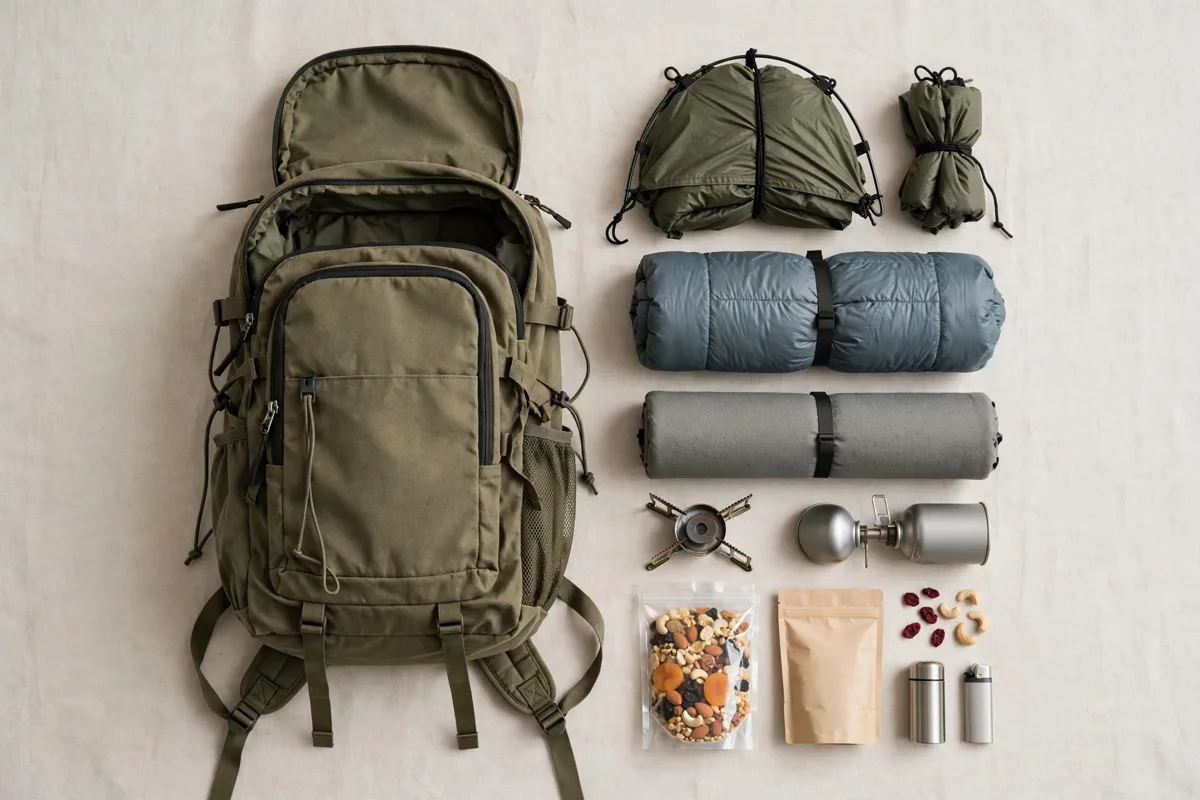
A three-day load is not a mystery you solve by buying a bag and stuffing it. Add the pieces up first. These are compressed, packed volumes for ordinary gear — not the smallest ultralight versions, and not the bulkiest car-camping versions:
| Part of the load | Packed volume | Notes |
|---|---|---|
| Sleeping bag or quilt | 7–13 L | The single biggest item for most people. A warm synthetic bag can take twice the room of a compact down quilt. |
| Tent or tarp shelter | 4–8 L | A one- or two-person tent with poles. A tarp and cord come in at 1–2 L and change the whole math. |
| Sleeping pad | 1–4 L | Inflatable pads pack small; foam pads pack huge but ride outside the bag. |
| Food for 3 days | 4–7 L | Freeze-dried and dense foods at the low end; fresh and bulky foods at the high end. Food does not compress. |
| Water you carry | 2–3 L | Two to three liters on your back is two to three liters of pack, whether it sits inside or in a hydration sleeve. |
| Clothes and layers | 5–10 L | A change of clothes plus insulation. Winter layers can double this line on their own. |
| Stove, pot, and fuel | 2–4 L | A nesting canister kit at the low end. Skip cooking and this line nearly vanishes. |
| Everything else | 4–7 L | First aid, light, knife, filter, hygiene, repair bits — a pile of small things that adds up to one medium thing. |
| Total | 29–53 L | Which is why the honest answer is a range, and why your gear — not the calendar — picks the number inside it. |
Four real packs, four answers to the same question
The four packs from our bug-out bag comparison sit at four different points on the scale, which makes them a useful ruler. Prices were re-checked for this page on October 22, 2026 against Keepa’s current data: three of the four had a live price today. The Eberlestock Switchblade did not — no current price could be confirmed for it today, so its cell is blank rather than filled with a stale number; our comparison carries its last verified price with its date. Each pack’s name below links to its current Amazon listing.
| Pack | Price | Capacity | Empty weight | The 3-day load it honestly fits |
|---|---|---|---|---|
| Eberlestock Switchblade Read the review ↓ |
— | 29.3 L (1,785 cu in) | 3.6 lb | A compact load only: tarp shelter, a small sleep kit, dense food. A tent and a bulky bag will not both fit. |
| 5.11 RUSH24 2.0 Read the review ↓ |
$140.00 | 37 L (2,275 cu in) | 3.84 lb | The center of the range: one person’s three days with compact gear, which is why our comparison calls it the right size for most three-day loads. |
| REEBOW GEAR 3-Day Read the review ↓ |
$29.99 | 40 L (claimed) | 2.82 lb* | On paper, the same center. In owner reports the seams and straps give out before the volume does — it passes the size test and fails the carry test first. |
| 5.11 RUSH72 2.0 Read the review ↓ |
$190.00 | 55 L (3,342 cu in) | 5.3 lb | Bulky gear, cold weather, or one person carrying shelter and food for two. For a solo summer load it is room you will fill with weight. |
Prices last checked: October 22, 2026
* REEBOW’s 2.82 lb comes from its Amazon listing; reseller write-ups of the same bag have printed 1.8 lb and 5.2 lb, and the maker publishes no denier and no warranty we could find. Claimed-vs-actual weights for all four packs are tracked in our bug-out bag comparison.
Is 40 liters enough for 3 days?
Yes — a 40-liter pack is enough for three days for most people, and it is the size we would hand a first-time buyer. Forty liters holds the worked example above at its middle settings: a compressed sleeping bag, a small tent or a tarp, three days of dense food, and a change of clothes. It stops being enough when two bulky things stack up — a synthetic winter bag and a full tent and fresh food — because each of those eats the margin the others were counting on.
Is this a bug-out bag or a backpacking trip? The answer changes a little
A bug-out load and a camping load ask for different liters, because they carry different things. The bug-out load our bag comparison sized — food and water carried, tarp shelter, tools, no stove-centered cooking — lands at 35 to 45 liters for one adult. A backpacking trip adds a real tent, a stove and pot, and a warmer sleep kit, and lands at 40 to 50. A three-day trip where you sleep indoors and carry only clothes and toiletries is a 30 to 40 liter job. Same three days on the calendar; three different bags.
Why do two 40-liter packs hold different amounts?
Two packs can both say 40 liters and hold different loads, because there is no rule every maker follows when counting. A standard test exists — ASTM F2153, which fills the pack with small balls and measures what fits — but makers differ on whether the lid, the outside pockets, and the stretchy front pocket count toward the number, and some publish a figure from the drawings rather than a measured fill. Treat the liter number as a size class, not a measurement: a 37 and a 40 are the same class of bag, whatever the labels imply. Shape matters too — a tall, narrow 40 liters swallows a tent pole and fights a wide sleeping pad, where a shorter, deeper 40 does the opposite.
What changes the number most — the season, or your gear?
Your gear changes the number most, and the season changes it through your gear. The swing item is the sleep kit: a compact down quilt packs to about 7 liters, a warm synthetic bag to 13 or more, and that one swap is worth a whole pack size. Winter then adds a warmer bag, a thicker pad, and real insulation layers at once — plan on 10 to 15 liters more than the same trip in summer. Splitting a tent and stove with a partner moves the other way, taking 4 to 8 liters off each person’s load.
Does a bigger pack make the load heavier?
A bigger pack makes the load heavier in practice, because empty space gets filled. The RUSH72 2.0 above is 55 liters and 5.3 lb empty; filled carelessly it becomes the 40-pound carry its owner reports complain about, while the same person with a 37-liter bag is forced to make the cuts at home, where cuts are free. Buy the smallest bag your written load list fits — then check the total with our Bug-Out Bag Weight Checker, because liters tell you whether it fits and pounds tell you whether you can carry it. A loaded three-day pack should stay under about a fifth of your body weight, and closer to a tenth is kinder.
The honest caveats
Three, and they all cut the same way. First, liter ratings are not standardized across brands, as the section above says — compare within a brand with more confidence than across brands. Second, a pack’s stated volume usually assumes every pocket stuffed to its seams; a main compartment you can actually organize is smaller than the headline number. Third, volume is not carry: of the four packs in the table, the one with the most honest 40 liters on paper is the one owners say carries the worst past 25 pounds. Size gets the gear in. Frame, belt, and build decide whether you arrive with it.
Questions readers ask
What size backpack do I need for 3 days?
Most people need 40 to 50 liters for three days of camping with their own tent, sleep kit, stove, and food. A three-day bug-out load lands at 35 to 45 liters, compact ultralight gear can fit 30 to 40, and winter or bulky gear needs 55 or more.
Is 35 liters enough for a 3-day trip?
Thirty-five liters is enough for three days if your sleep kit is compact, your shelter is a tarp or a small tent, and your food is dense — the Eberlestock Switchblade does it at 29.3 liters with exactly that load. With a bulky sleeping bag or a full-size tent, 35 liters runs out before the list does.
Is 50 liters too big for a weekend?
No — 50 liters is the top of the normal weekend range, not overkill. It earns its size with bulky gear, cold weather, or shared equipment carried for two. The risk is not the bag; it is filling the extra room with weight you then have to carry for three days.
How do I work out how many liters my own gear takes?
Pack your full three-day load into a cardboard box or a storage tote, keeping it packed the way it would ride. Measure the inside of the filled space in inches and multiply length × width × height, then divide by 61 — that is your gear’s volume in liters. Add a few liters of working room and buy to that number.
Does pack volume include the outside pockets?
Sometimes — and that is the problem. Some makers count only closable compartments, others count the lid and every outside pocket, and a few count stretch pockets at full stretch. There is an ASTM test for pack volume, but no rule that every brand must use it the same way, so treat liters as a size class.
How heavy should a loaded 3-day pack be?
Keep a loaded three-day pack under about a fifth of your body weight, and under roughly 25 to 30 pounds for most adults if you can. Water decides much of it: three liters of water is about 6.6 pounds before food, bag, or shelter go in. Weigh the pack loaded, on a bathroom scale, not by feel.
Keep reading
This page is part of our Packs & Bags hub. The bags named here are scored head-to-head in Best Bug-Out Bags Compared, with the claimed-vs-actual weight tracking this page borrowed from. Before a trip, run the packed result through the Bug-Out Bag Weight Checker and the Gear-Ready Emergency Checklist — one tells you what the load weighs, the other makes sure nothing on the list stayed in the garage.
Prices last checked: October 22, 2026 (Keepa current data). Three packs had a live price today; the Switchblade’s price could not be confirmed today and is left blank — its last verified price, from October 20, 2026, is in our bug-out bag comparison. Prices and availability change.
Talk it over with other readers. The Shelter Tactics Community on Facebook is where readers compare notes on knives, lights, packs, and the rest of the kit — and where your questions help decide what we research next. Join the group →