Last updated: October 31, 2026
Affiliate Disclosure: Shelter Tactics is reader-supported. When you buy through links on this page, we may earn a commission at no extra cost to you. As an Amazon Associate, Shelter Tactics earns from qualifying purchases. Learn more.
The short answer: For a 20°F night on frozen ground, most sleepers need a pad rated R 5 or higher under them — and R 6 to 7 is the comfortable end of the range, especially on snow. Cold sleepers should start at R 6. Anything near R 2 is a summer pad, and no sleeping bag, however warm its tag sounds, makes up for one.
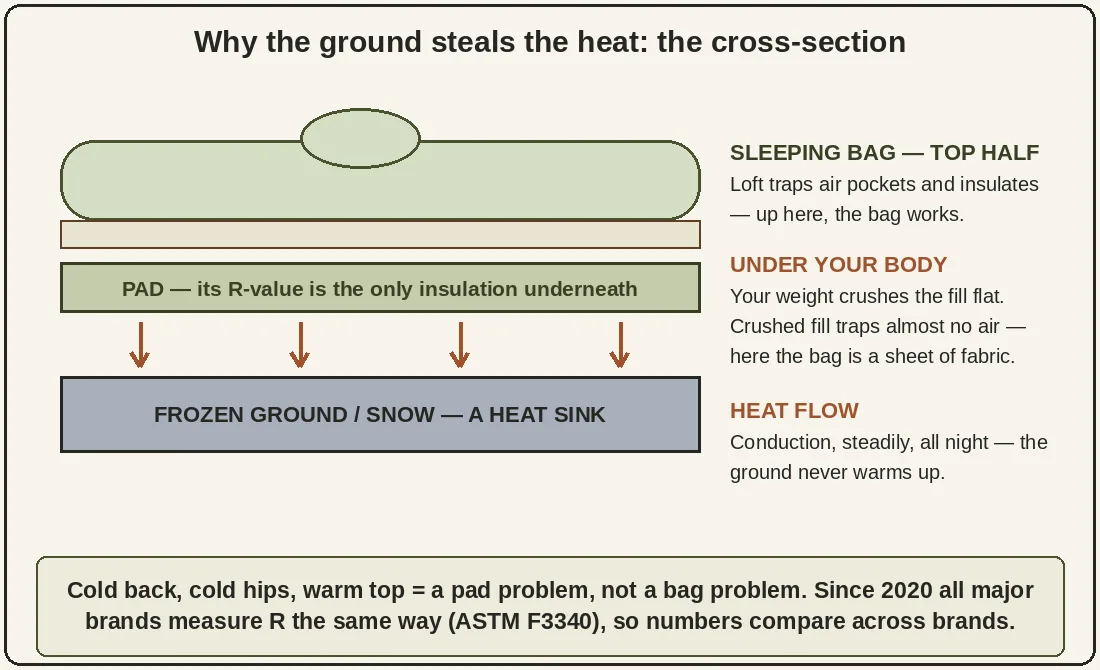
Why the ground steals the heat
A sleeping bag keeps you warm with loft: thousands of small air pockets trapped in down or synthetic fill. The half underneath you gets none of that benefit. Your body weight crushes it flat against the pad, and crushed fill traps almost no air. Under your torso, hips, and shoulders, the bag is effectively a sheet of fabric.
That leaves the pad doing all the insulating work against the coldest surface in camp. Frozen ground and snow pull heat out of you by conduction, steadily, all night — you are lying on a heat sink that never warms up. The air above you can be calm while the ground drains you from below, which is why campers report being cold from underneath in a bag that should have been plenty: cold back, cold hips, warm top. That pattern is a pad problem, not a bag problem.
R-value is the pad’s resistance to that heat flow, and since 2020 the major brands have measured it the same way, under the ASTM F3340 standard. Before the standard, each maker ran its own test and the numbers could not be compared across brands. An ASTM R 7.3 from one maker now means the same thing as an ASTM R 7.3 from another, so the table further down this page is a real comparison rather than six separate marketing claims. The same pad also insulates the same amount at 30°F and at 10°F — what changes with the temperature is how much insulation you need.
The R-value floor by temperature
No single official chart maps R-value to temperature — pad makers publish guidance bands, and they broadly agree. The floor below is built from those bands, adjusted for what the bands tend to understate: frozen ground conducts harder than the cool dirt of a fall night, and snow is worse again. Treat the minimum column as the line below which a typical sleeper starts losing the night, and the comfortable column as where most people should actually aim.
| Ground / night low | Minimum R | Comfortable R |
|---|---|---|
| Above 40°F, bare ground | 2 | 3 |
| 30–40°F, cold ground | 3 | 4–4.5 |
| 20–30°F, frozen ground | 5 | 5.5–6.5 |
| 10–20°F, snow | 5.5 | 6.5–7.5 |
| Below 10°F, snow camping | 6.5 | 7.5 or stacked pads |
For the 20°F night this page is about, read the middle row: R 5 gets a typical sleeper through it, and R 6 to 7 is where the night stops being a negotiation. Two things push you toward the comfortable column: the ground itself — snow or frozen mineral soil pulls more heat than the same air temperature over leaf litter — and you. If you know you sleep cold, the minimum column was not written for you; start one row down.
One more number explains half the cold nights behind this question. Sleeping bag ratings are not tested on a bare floor: under the EN/ISO test, the heated manikin lies on a flat pad rated roughly R 4.8 to just over R 5. The tag quietly assumes you own a winter-weight pad. Put that same “20-degree bag” on a summer pad at R 2 and you have removed about three points of insulation the test counted on — the system rated to 20°F now sleeps cold somewhere around 35°F. The bag did not change. The floor under it did. Our Sleep System Temperature Calculator runs exactly this trade for your own numbers.
The pads, by the makers’ numbers
These are the pads readers cross-shop for cold ground, with each maker’s published ASTM R-value and Regular-size weight; the NEMO figure is its Regular Mummy minimum weight. Read the table against the floor above: at 20°F, the top three clear it on their own, the middle two fall just short, and the foam pad at the bottom was never meant to work alone — its job is the next section.
| Pad | R-value | Weight | Type |
|---|---|---|---|
| NEMO Tensor Extreme Conditions | 8.5 | 1 lb 1 oz | Insulated inflatable |
| Sea to Summit Ether Light XR Pro Insulated | 7.4 | 19.8 oz | Insulated inflatable |
| Therm-a-Rest NeoAir XTherm NXT | 7.3 | 15.5 oz | Insulated inflatable |
| Big Agnes Rapide SL Insulated | 4.8 | 1 lb 2 oz | Insulated inflatable |
| Therm-a-Rest NeoAir XLite NXT | 4.5 | 13 oz | Insulated inflatable |
| Therm-a-Rest Z Lite Sol | 2.0 | 14 oz | Closed-cell foam |
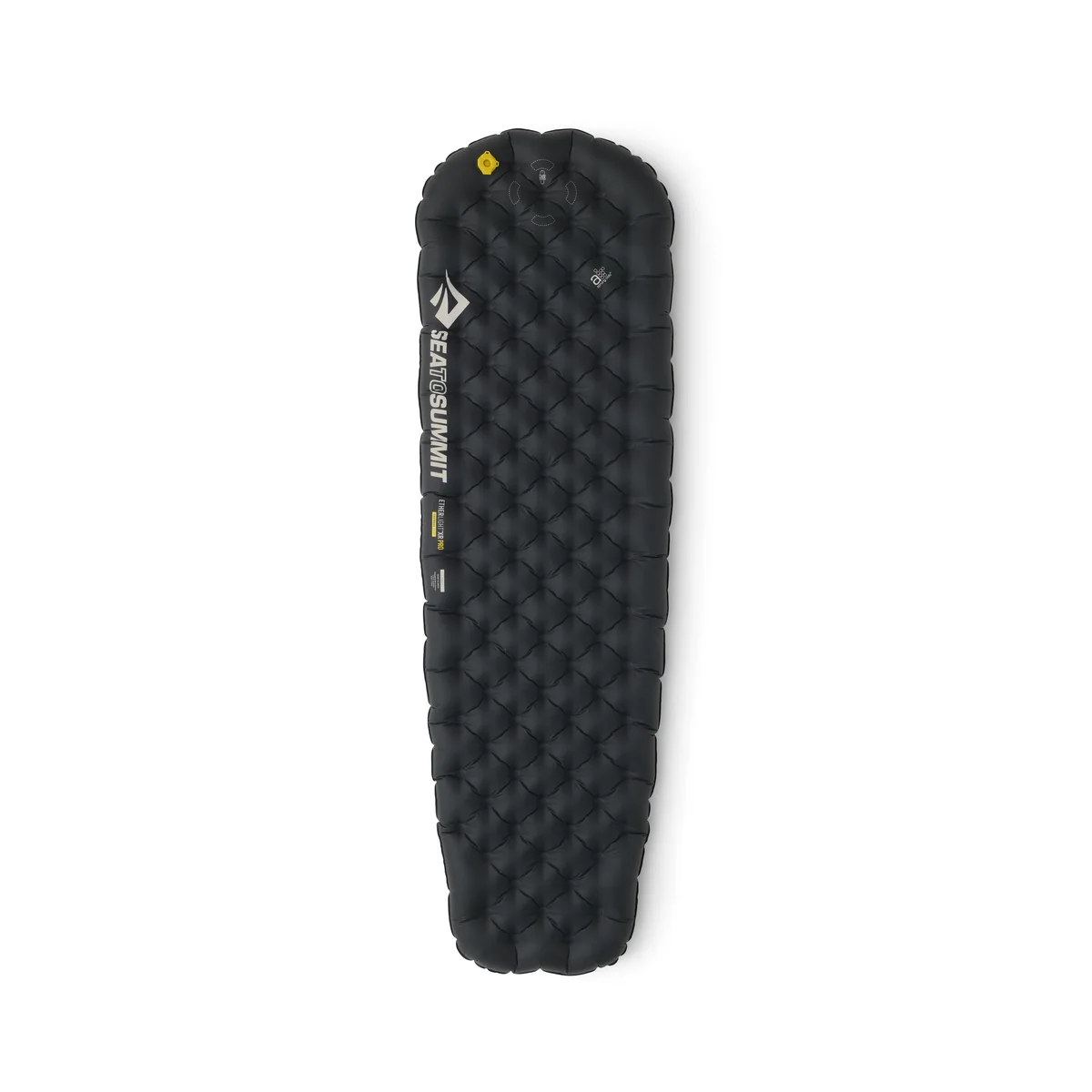
Photo: Sea to Summit
The NEMO Tensor Extreme Conditions posts the highest number on the table, R 8.5, at a weight close to the XTherm’s — on paper, the warmest backpacking pad in this group. Sea to Summit’s entry is the new Ether Light XR Pro Insulated, which replaces the discontinued Ether Light XT Extreme — and the swap is an upgrade: R 7.4 against the old pad’s R 6.2, 19.8 ounces in Regular, with the same 3.9-inch Air Sprung Cell build, a point side sleepers tend to care about as much as the R-value. It clears the 20°F comfortable band on its own. The XTherm NXT sits one step below at R 7.3 while weighing less than a pound — the default winter answer for years: it clears the 20°F comfortable band by itself, with margin for colder.
Below the line sit two good three-season pads being asked to do a winter job. The Big Agnes Rapide SL Insulated at R 4.8 and the NeoAir XLite NXT at R 4.5 are both close enough to tempt people — and at 20°F on frozen ground, “close” is the difference between sleeping and shivering at 3 a.m. Both need help at this temperature, and the help is cheap.
Therm-a-Rest NeoAir XTherm NXT
The two-pad stacking math
R-values add. That is not a rule of thumb — it follows from what R-value measures. Each pad resists heat flow, and stacking two resistances in series adds them. Pad makers and REI both state the rule plainly, and it turns the shortfall pads above into a winter system:
- A closed-cell foam pad at R 2.0 under an inflatable at R 4.5 gives you R 6.5 — squarely in the comfortable band for 20°F, from a three-season pad many campers already own plus the cheapest pad on the table.
- The same foam pad under the R 4.8 Rapide SL gives R 6.8.
- Foam under the XTherm gives R 9.3, which is deep-winter territory and more than a 20°F night asks for.
The foam pad goes on the ground, the inflatable on top. Set up that way it does three jobs beyond the arithmetic. It shields the inflatable — the expensive, puncturable half of the system — from sharp frozen ground and ice edges. It adds friction, so the inflatable creeps less. And it is insurance: if the inflatable goes flat at 2 a.m., you are sleeping on R 2.0 of foam instead of frozen dirt. That will not be a warm night, but it is the difference between a bad night and a genuine problem. In summer the same foam pad works alone — the pair covers more of the year than either does by itself.
Stacking math: what the foam pad buys
Combined R-values for the stacks worked in this section, each built on the R 2.0 closed-cell foam pad — R-values add, because each pad resists the same heat flow in series.
Every stack clears the floor: the XLite stack lands at the top of the comfortable band (R 5.5–6.5), the Rapide stack just past it. Foam goes on the ground, inflatable on top.
Cold sleepers, women, and side sleepers
The floor table is written for a typical sleeper, and many people asking this question are not typical sleepers. If you are cold in beds other people find warm, plan on the comfortable column plus a margin — at 20°F, R 6.5 or better, or the stacked system. There is no prize for finding your exact minimum the hard way.
Women, on average, sleep colder than men, which is why the EN/ISO system publishes separate comfort and limit numbers: comfort is modeled on a typical woman, limit on a typical man, and the gap usually runs 8–12 degrees. If your bag’s headline number is a limit rating and you sleep cold, your pad is carrying more of the load than the tag admits. Budget the extra R — the stacked foam pad is the cheapest way to buy it.
Side sleepers have a mechanical problem on top of the thermal one. Your weight concentrates on a shoulder and a hip, compressing the pad further at exactly those points, and a thin or underinflated pad can let a hip bottom out toward the ground. The fix is thickness as much as R-value: a 3- to 3.5-inch inflatable, firm enough that your hip stays off the floor when you roll onto it. Check that lying down, not by pressing a thumb into the pad — a thumb tells you almost nothing. A wide version is worth its small weight penalty if your elbows keep landing on the tent floor.
Questions readers ask next
Are quilts for side sleepers?
Yes — quilts suit side sleepers well, arguably better than mummy bags. There is no zipper or hood to fight when you roll, and the insulation under you is crushed flat anyway, which is the part a quilt leaves off. Choose a wide quilt, learn the pad-strap system, and carry a warm hat: a quilt has no hood.
Should I use a hammock underquilt or a pad?
An underquilt is the warmer, more comfortable answer in a hammock: it hangs below you, so your weight never crushes its loft, and it wraps the sides a flat pad leaves exposed. A pad works — wide, partly deflated so it bends with the hammock — but it shifts, and its edges are cold spots.
Why does my 30-degree bag leave me cold?
Usually one of four things: the 30 is a limit or survival number, not a comfort rating; the pad is a summer pad, while the rating test assumed roughly R 5; the bag was damp or stored compressed, costing loft; or you went to bed cold or hungry. The pad is the most common culprit.
Can I use two cheaper pads instead of one expensive one?
Yes — the math on this page is exactly that trade. R-values add, so a foam pad at R 2.0 under a mid-range inflatable at R 4.5 reaches R 6.5, past the 20°F floor, for less than most single winter pads. The costs are bulk — the foam rides outside the pack — and a firmer bed.
More questions like this: this page is one answer from What People Are Asking About Sleep Systems.
Keep reading
- What People Are Asking About Sleep Systems — the rest of the sleep-system questions, with their short answers.
- Shelter & Sleep — our shelter and sleep-system guides.
- Sleep System Temperature Calculator — your bag’s printed rating, translated for your pad and how you sleep.
- Hammocks Compared — the other way to leave the ground.
Talk it over with other readers. The Shelter Tactics Community on Facebook is where readers compare notes on knives, lights, packs, and the rest of the kit — and where your questions help decide what we research next. Join the group →