
Last updated: November 1, 2026
Affiliate Disclosure: Shelter Tactics is reader-supported. When you buy through links on this page, we may earn a commission at no extra cost to you. As an Amazon Associate, Shelter Tactics earns from qualifying purchases. Learn more.
The short answer: find a repeater near you in the myGMRS.com directory, set your radio to that repeater’s channel (15R–22R) with its listed tone, and get the owner’s OK if the listing asks for it — then your handheld, which reaches about a mile on its own in the woods, borrows the repeater’s hilltop antenna and talks across its whole footprint instead.
This is the question that arrives right after the license one, which our GMRS license explainer covers. This page is the next step. Nothing below needs a test or a second license — just the right radio, two numbers (a channel and a tone), and one piece of manners that is also a rule: the repeater belongs to somebody.
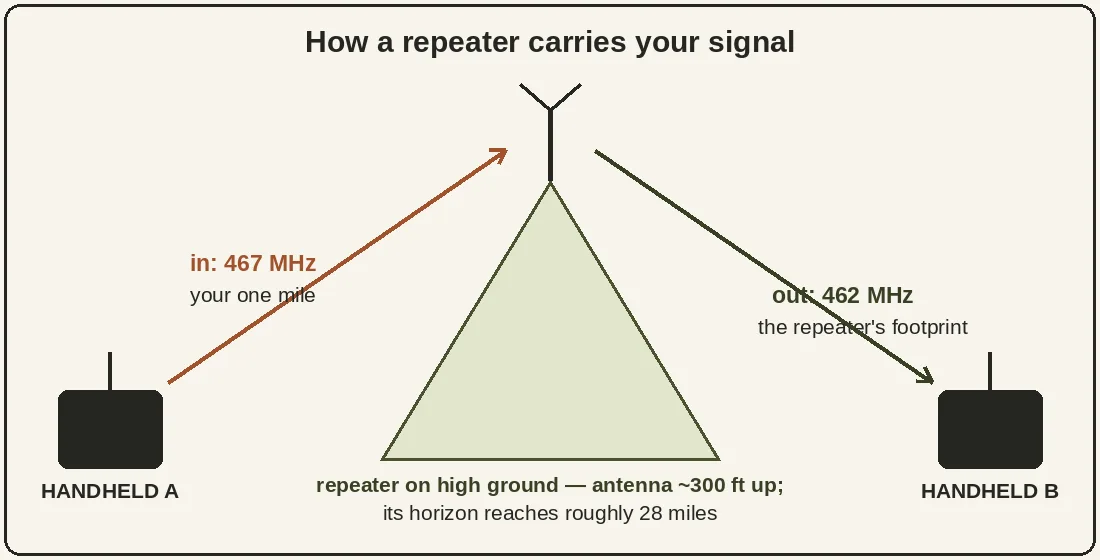
What a repeater actually does
A repeater is a radio parked somewhere high — a hilltop, a tower, a tall roof — doing two jobs at once. It listens on one frequency, the input, and rebroadcasts everything it hears, at the same moment, on a second frequency, the output. Your handheld only has to reach the hilltop, which is usually easy, because the hilltop can see you. Its antenna does the long part.
That trade is the whole trick. Two handhelds at head height top out near six miles before the earth’s curve gets in the way, and trees cut that to a mile or so — our Two-Way Radio Reality Check runs that math properly. Put one antenna 300 feet up, as a repeater does, and the ceiling lifts to roughly 28 miles. Your one mile did not get stronger; it got replaced by the repeater’s footprint.
The three things you need before you transmit
1. A repeater-capable radio. This is the trap, because the box rarely says it plainly. A repeater radio transmits on the 467 MHz inputs while listening on the 462 MHz outputs — two frequencies at once, called duplex. Plenty of GMRS radios cannot do it. The Midland GXT1000 handhelds are the standard example: Midland’s own lineup chart lists them as not repeater capable, and owners can hear a repeater — the output sits on an ordinary channel — but never answer it. Radioddity’s GMRS handhelds (the GM-30, the UV-5G line) are built repeater-capable, and Midland’s MXT mobiles carry eight repeater channels as a headline feature. Check the spec sheet for “repeater capable” before you buy.
2. The output channel and the tone. Every repeater works on one of the eight pairs below, and most require a tone — a quiet code your radio sends to open it. The listing gives you both. No tone, no opening: the repeater hears you and ignores you, which feels like being out of range.
3. The owner’s OK. Repeaters are owned by individuals and clubs, not by the FCC and not by the public. Many are listed as open — any licensed operator is welcome without asking. Others ask you to request permission first, and a few are private; the listing says which. Owners generally want a call sign before they say yes, so have the license first. One $35 license covers you and your whole immediate family under one call sign, so the family radios ride on the same permission.
Before you buy a radio for repeater work
Your next step, if a radio purchase is part of this: check the spec sheet for the words “repeater capable” before anything else, and run your ground through our Two-Way Radio Reality Check — it models what a handheld honestly reaches on your terrain, and its radio shelf is where the GMRS handhelds we track live, with their tracked links. A radio that cannot transmit on the 467 MHz inputs can only ever listen to a repeater, however good its reviews are.
The eight repeater pairs
GMRS has exactly eight repeater pairs. Your radio listens on the 462 MHz output and transmits on the matching 467 MHz input — the +5 MHz offset. A repeater-capable radio shifts on its own when you pick an R channel; you never dial the input.
| Channel | Output — you listen | Input — you transmit |
|---|---|---|
| 15R | 462.550 MHz | 467.550 MHz |
| 16R | 462.575 MHz | 467.575 MHz |
| 17R | 462.600 MHz | 467.600 MHz |
| 18R | 462.625 MHz | 467.625 MHz |
| 19R | 462.650 MHz | 467.650 MHz |
| 20R | 462.675 MHz | 467.675 MHz |
| 21R | 462.700 MHz | 467.700 MHz |
| 22R | 462.725 MHz | 467.725 MHz |
Two things the table cannot tell you. First, the tone: each owner sets it, so two repeaters on 16R in one county can use different ones — the pair alone does not get you on. Second, the outputs double as ordinary channels 15–22, so you will also hear radio-to-radio talk on the same frequency. That is normal.
Tones: the part that trips everyone
A tone is a code riding under your voice. CTCSS is an analog tone named in hertz — 141.3 Hz, the common one, is nicknamed the travel tone because so many open repeaters use it. DCS (also printed CDCSS) is a digital code named as a three-digit number. A radio set for one cannot open a repeater set for the other.
The part nobody explains is that a repeater has two tone slots doing different work. The input tone is the one your radio must send: the repeater sits locked until it hears it, then opens and repeats you. Get it wrong and nothing happens. The output tone is the one the repeater sends back, and your radio does not need it. Require it and your speaker stays quiet except for that repeater; leave receive tone off and you hear everything on the channel — the better setting until your first contact works.
Some repeaters use split tones: one tone in, a different one out — partly to keep out people who found the output tone by scanning and never asked. Split tones are where simple radios fall down: many allow only one tone per channel, so a split-tone repeater stays closed to them. Radios that handle them say so; Midland’s MXT mobiles list “split tone capable” for this reason. And tones are not privacy: a tone only decides whose speaker opens — anyone with no tone set hears every word.
How to find a repeater near you
Start at myGMRS.com, the directory nearly every GMRS owner uses. Search by town or ZIP and it maps the repeaters around you, each with its pair, its input and output tones, a coverage estimate, and its status — open, permission required, or private. Permission listings carry a request button or the owner’s contact; send your call sign and a short note.
Then run the free test before transmitting: program the channel, leave receive tone off, and listen for a few evenings. A live repeater identifies itself, carries conversations, and often runs a scheduled net — a weekly check-in where operators say hello in turn. A net is the friendliest first contact there is; new call signs are the point of it.
Your first contact, step by step
- Listen first. Sit on the output and learn its rhythm.
- Check your settings. Repeater channel selected, input tone set to the listing’s tone, receive tone off.
- Wait for a gap. A repeater carries one conversation at a time. Let it finish; leave a breath after the tail drops.
- Key up and say who you are. Call sign first — “[your call sign], listening” — or ask for a radio check. Keep it short.
- Talk in short turns. Say your piece, release the button, and leave gaps so someone else can get in.
- Close with your call sign. At the end of a conversation, and at least every 15 minutes during a long one. Family on your license use the same call sign.
If nobody answers, suspect settings, not distance: wrong input tone first, a non-repeater-capable radio second, a repeater off the air or permission-only third.
Etiquette and the legal lines
The etiquette is mostly the obvious kind. Listen more than you talk. Keep transmissions short — a repeater is shared by everyone in its footprint. Do not interrupt a conversation unless yours is an emergency, and give emergency traffic the channel at once. Learn the owner’s rules: some welcome long chats; working club machines ask that routine traffic stay brief.
The legal lines are short, because ham-radio rules get pasted onto GMRS where they do not belong. GMRS exists for family and group coordination — your household, your hunting party, your convoy — and ordinary personal traffic is the point of the service, not a violation. What GMRS does not allow: encryption, or any code meant to hide what you mean; connecting a station to the telephone network to carry conversations — no phone patches for routine use; and transmitting without the license, or on a radio the FCC has not certified for GMRS. Stay inside those, identify with your call sign, and honor the owner’s permission.
Questions readers ask next
Can a GMRS radio talk to FRS walkie-talkies?
Yes — GMRS and FRS share the same 22 channels, so a GMRS handheld and the kids’ FRS radios talk radio-to-radio on any shared channel, same tone set. The limits ride with the FRS radio: 2 watts, fixed antenna, no repeater access. A mixed group talks on a plain channel, not through a repeater.
Why does my “35-mile” radio reach about a mile?
The box number assumes high antennas and a clear path — repeater conditions. Two handhelds at head height hit the earth’s curve at roughly six miles, and our Reality Check puts dense woods at a quarter to half of that ceiling. A mile in the trees is the honest number.
GMRS or ham radio — which should my family get?
GMRS, for most families. One $35 license covers the whole immediate family with no test, and every member uses the same call sign. Ham radio gives one person far more frequencies and range, but every operator needs their own license and a passed exam. Families coordinating nearby belong on GMRS; hobbyists chasing distance, on ham.
Do I need a license for a Baofeng?
It depends which Baofeng. The common UV-5R is a ham radio, not FCC-certified for GMRS, so no GMRS license makes transmitting with it on GMRS legal — listening is fine. Certified GMRS models such as the UV-5G are ordinary GMRS radios: legal with the $35 license, repeaters included.
More questions like this: this page is one answer from What People Are Asking About GMRS Radios.
Keep reading
The full set of radio questions lives on What People Are Asking About GMRS Radios, and the wider shelf is our Safety & Communication hub. Still need the license itself? GMRS License Explained walks the application in order. And before judging any radio by its box, run your ground through the Two-Way Radio Reality Check.
Talk it over with other readers. The Shelter Tactics Community on Facebook is where readers compare notes on knives, lights, packs, and the rest of the kit — and where your questions help decide what we research next. Join the group →