
Last updated: November 1, 2026
Affiliate Disclosure: Shelter Tactics is reader-supported. When you buy through links on this page, we may earn a commission at no extra cost to you. As an Amazon Associate, Shelter Tactics earns from qualifying purchases. Learn more.
The short answer: a get-home bag lives in your car or office and covers the trip home — about 24 hours, light enough to walk in all day, under roughly 12 pounds — while a bug-out bag lives by your front door and covers leaving home for 72 hours. They solve opposite trips, which is why one bag built to do both usually does neither well.
Most people meet these two bags as one idea — “the emergency backpack” — and build a single heavy bag that sits in a closet at home. That bag is in the wrong building on the day it matters. If the emergency happens while you are at work or stuck in dead traffic, the problem is not leaving home; it is getting back to it. Splitting the job in two is the fix, and each half gets lighter and cheaper for it.
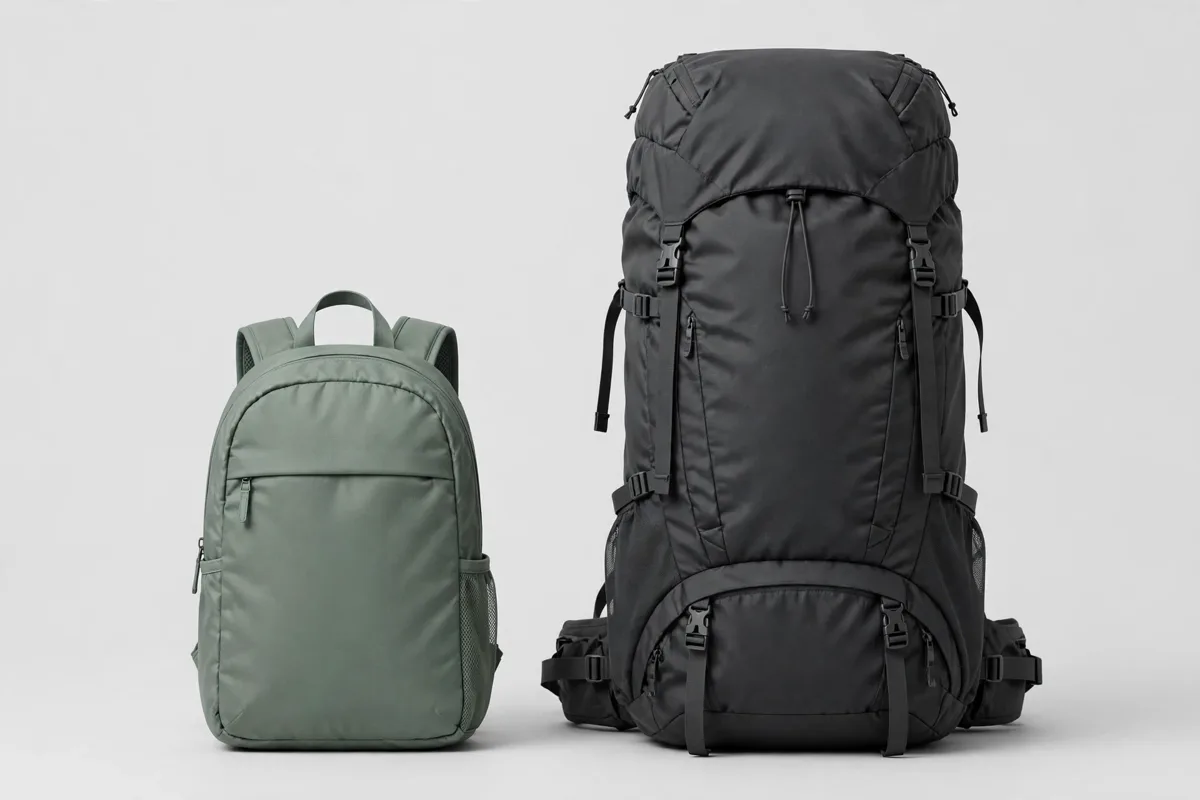
Two bags, two opposite trips
The get-home bag starts away from home. It lives in the trunk, under a desk, or in a locker, and its one job is the trip back: for most people a drive that turns into a walk, or a walk outright, of up to about 25 miles. At roughly 3 miles an hour, 25 miles is a full day on your feet — which is why the bag is built around 24 hours, not three days. It carries what a day demands and nothing more: light enough to wear all day, cheap enough to leave in a hot trunk for a year without wincing.
The bug-out bag starts at home. It lives by the door, packed, and its job is the opposite trip: leaving, with 72 hours of food, water, and shelter, because the house is the thing that has become unusable — fire, flood, a gas leak, an evacuation order. Seventy-two hours is the standard planning window because it is roughly how long organized help takes to arrive in a serious event. This bag can be bigger and heavier, because it starts on your back at your own front step, not after a day of surprises — but it still has a hard weight ceiling, set out below.
The two bags, side by side
| Get-home bag | Bug-out bag | |
|---|---|---|
| Job | Get you home | Get you away, 72 hrs |
| Lives | Car trunk or office | By the door at home |
| Time it covers | About 24 hours | 72 hours |
| Weight target | Under ~12 lb | Under 1/5 body weight |
| Water | 1–2 L + small filter | 2–3 L + filter/treatment |
| Food | Bars only, no cooking | 3 days of real meals |
| Shelter layer | Rain shell, warm layer | Tarp or tent, sleep kit |
| Footwear | Walking shoes, in the car | Boots you already own |
| Cash / papers | Small bills, local map | Cash roll, copies of IDs |
Read the weight row twice, because it is where the two bags part company. The get-home number is absolute — about 12 pounds — because the walk sets it: a bag you carry for eight hours has to disappear on your back. The bug-out number is relative. Our pack-size page (post 240) states the rule the Bug-Out Bag Weight Checker is built on: keep a loaded three-day pack under about a fifth of your body weight, and closer to a tenth is kinder. For a 150-pound person that is a 30-pound ceiling and a 15-pound ideal; most adults land in the 20–25 pound range in practice, which is also where the packs in our bug-out bag comparison stay comfortable.
Water and food: where the math splits
Water is the heaviest thing in either bag — a liter weighs about 2.2 pounds — and it is why the two bags treat it differently. The get-home bag carries the trip: one to two liters in the bag, plus a small filter or treatment tablets so a tap, a fountain, or a creek along the route refills it. You are walking toward the best water storage you own, which is your house.
The bug-out bag cannot carry its whole answer. Three days of water at a spare gallon a day would weigh about 25 pounds by itself — the entire budget, spent on water alone. So it carries two to three liters to start, plus the means to make more: a filter, treatment, and a fillable container. Food splits the same way. The get-home bag carries bars — dense, no cooking, eaten while walking. The bug-out bag carries three days of actual meals, and a stove and pot earn their room on a 72-hour load as they never do on a walk home.
Water weight: what each bag actually carries
Pounds of water alone, at the 2.2 lb per liter this section uses — top of each bag’s carried range, against carrying the bug-out bag’s full three days.
The 25 lb row is the whole weight budget spent on water alone — which is why the bug-out bag carries a filter and a fillable container instead.
The item everyone forgets: shoes
The single most useful thing in a get-home bag is not in the bag. It is the pair of broken-in walking shoes that lives in the trunk beside it. The walk home does not arrive on a day you dressed for it; it arrives on a workday, in work shoes, dress shoes, or heels — footwear that turns mile six into an injury. Our Gear-Ready Emergency Checklist makes the same point for the home kit, but it applies double here: a 12-pound bag and the wrong shoes is a worse kit than a 15-pound bag and the right ones. Add socks, too. A fresh pair at the halfway point is worth more than most of the gear people shop for.
The mistake: one heavy bag that does neither job
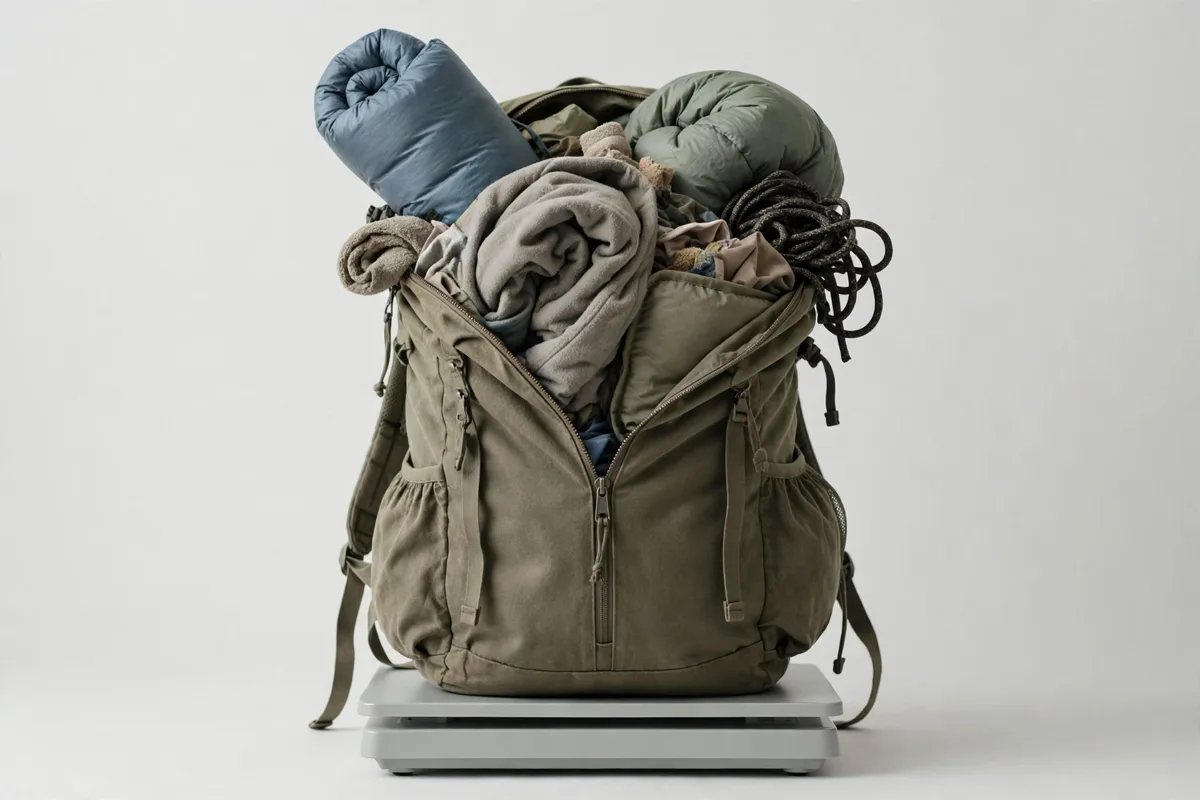
Here is how the usual build goes wrong. One bag gets packed for 72 hours — tent, stove, three days of food, tools — because that list is more interesting to shop for. It ends up at 30 pounds or more. A 30-pound bag cannot live in a trunk rotation and nobody wants to walk 20 miles in it, so it goes in the hall closet at home, where it serves exactly one of the two scenarios and the less likely one at that. The evacuation it was built for may never come. The breakdown, the road closure, the ice storm that strands you across town — those come every few years.
The fix is splitting, and the relief is that the two bags share almost nothing. That sounds expensive until you price the get-home half honestly: it is bars, water, a filter, a rain shell, a light, a small first-aid kit, cash, and a paper map, in a bag that does not need to be good — it needs to be present. The money saved by not duplicating the expensive shelter and sleep gear is what funds doing the bug-out bag properly. Build the car bag first, because it covers the trip you actually make every day, then build the door bag to the weight rule above.
REEBOW GEAR 3-Day Pack
5.11 RUSH24 2.0
Why these two, briefly. The REEBOW claims 40 liters and weighs 2.82 pounds empty by its listing — and our comparison is plain about its limits: owners report seams and straps complaining under heavy, repeated loads past about 25 pounds. A get-home load never asks that of it. It asks the bag to sit ready and carry 12 pounds once. The RUSH24 2.0 makes the opposite case: 37 liters, 3.84 pounds empty, and the deepest long-term owner record in the comparison — the bag you load to 25 pounds and trust. Each bag is matched to the job its record supports.
Do you actually need both?
Most people do, because most people spend most of their hours somewhere other than home. If you work from home and rarely range far, the get-home bag shrinks to a small car kit — water, shoes, a layer, a light — for the trips you do make, and the door bag does the heavy lifting. If you rent, move often, or are building on a tight budget, build the get-home bag first and let it be your only bag while the bug-out bag is a written list and a savings target. What does not work is the reverse order: a perfect 72-hour bag at home and nothing in the car is a plan for the rarer problem.
Questions readers ask next
How often should I check and rotate the bags?
Twice a year, on the clock-change weekends, is the rhythm that sticks. Eat or replace the bars, swap stored water, check batteries, and trade the warm layer for the light one as the season turns. The trunk bag needs it most — summer heat is hard on food and batteries — so check it first.
How much cash should be in the bag?
Enough for a tank of gas, a cheap motel room, and food for a day, in small bills — ones, fives, and tens, because a card reader that is down cannot make change for a hundred either. The get-home bag needs the smaller share; the bug-out bag carries the main roll, sealed against water.
Pack cover or liner — which keeps the bag dry?
A liner, for both bags. Neither pack style here is waterproof; the fabric sheds a shower and seeps in a storm. A cover leaves the back panel open and snags, while a liner or dry bags inside protect the sleep kit and clothes no matter which way the rain comes. The cover is the extra, not the answer.
What should I shed from my bug-out bag?
Start with anything you packed two of, then the heaviest single item you cannot name a use for. Water and food are the honest weight; tools are where bags quietly gain five pounds. Weigh the bag, take out a quarter of it, and walk a mile — the checker and your shoulders will agree on what stays out.
More questions like this: this page is one answer from What People Are Asking About Bug-Out Bags.
Keep reading
All thirteen bag questions and their short answers are gathered on What People Are Asking About Bug-Out Bags, and the full shelf lives on our Packs & Bags hub. The bags named here are scored head-to-head in Best Bug-Out Bags Compared; sizing a three-day load is worked through in What Size Backpack Do I Need for 3 Days?; and the contents both bags draw from are listed in the Gear-Ready Emergency Checklist.
Talk it over with other readers. The Shelter Tactics Community on Facebook is where readers compare notes on knives, lights, packs, and the rest of the kit — and where your questions help decide what we research next. Join the group →