Last updated: November 1, 2026
Affiliate Disclosure: Shelter Tactics is reader-supported. When you buy through links on this page, we may earn a commission at no extra cost to you. As an Amazon Associate, Shelter Tactics earns from qualifying purchases. Learn more.
The short answer: If wood work is genuinely in the plan — batoning fuel, carving, shelter building — the survival kit’s knife is a fixed blade: it has no pivot to fail, its spine takes baton strikes a folder’s lock should never be asked to, and the good ones start at 4 ounces carried. If the kit’s realistic work is cord, packaging, food, and first aid, a locking folder plus a multitool covers it at half the carry bulk, and the fixed blade is weight spent on a job that will not happen. The rule is not which knife is better. It is which work is real.
The numbers this desk already holds
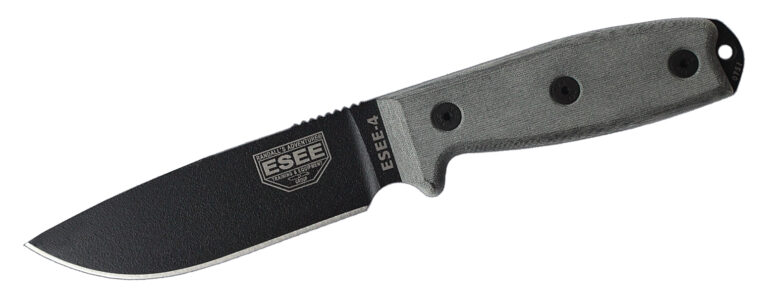
Our fixed-blade knives compared dataset weighs six fixed blades with their sheaths, and the spread is the first surprise for readers who assume fixed means heavy: the Morakniv Companion carries at 4.1 oz with a 0.10 in spine; the Morakniv Garberg at 9.6 oz with a 0.126 in spine; the ESEE-4 at 11.0 oz with a 0.1875 in spine; the Ka-Bar Becker BK2 at 16 oz for the knife alone, before its sheath. A typical locking folder of survival size runs about 3 to 5 oz, and the multitools in our bug-out bag multitool comparison carry a plain blade among their tools at 5 to 9 oz for the whole tool. So the weight argument cuts less cleanly than either camp claims: the lightest serious fixed blade matches a folder ounce for ounce, and the heaviest fixed blade costs more than a folder and a multitool combined.
Failure modes: the real difference
| Fixed blade | Folding knife | |
|---|---|---|
| Structure | One piece of steel, tang through the handle | A pivot, a lock, and small moving parts |
| Batoning wood | Designed for it — spine strikes are normal use | Abuse — strikes load the lock and pivot, the parts that can fail |
| What breaks | The tip or edge, under serious abuse — and the knife still cuts | The lock or pivot — and the knife is done |
| Cold, gloves, one hand | Draw and use; nothing to deploy | Deployment is a mechanism, and mechanisms and gloves argue |
Dirt is the folder’s quiet enemy. A pivot packed with grit, sap, or dried food gets stiff and then gets unreliable, and a lock you cannot fully trust changes how you use the knife — gingerly, which is its own risk. A fixed blade’s maintenance is a wash and a stropping. None of this makes folders fragile: a well-made locking folder survives years of ordinary work, which is the point. Ordinary work is not the test a survival kit is packed for. The kit exists for the day the work stops being ordinary.
When the folder is the right answer
Honestly and often. An urban get-home kit — the bag from get-home bag vs bug-out bag — faces seatbelts, packaging, cord, food, and bandages, and faces them in places where a fixed blade on a belt is a legal and social problem a folder in a pocket is not. A vehicle kit that will be used by family members of mixed skill is safer with a folder’s closed carry. And any kit whose owner will simply not carry 11 extra ounces is better served by the folder that is actually in it: the best survival knife remains the one present, and presence is a weight and bulk decision before it is a metallurgy decision. In those kits, pair the folder with a multitool and the pair covers every realistic task except splitting wood — and a get-home walk that requires splitting wood has gone wrong in ways a knife choice will not fix.
The desk’s rule
Fixed blade if the kit is built around fire and shelter — if there is a ferro rod in it, a tarp in it, and a plan that sleeps outside. Folder plus multitool if the kit is built around distance and people — roads, vehicles, buildings, a walk home. Both if weight allows and the kit is a vehicle bag, where ounces are cheap: the folder rides on the person, the fixed blade rides in the bag, and each covers the other’s bad day. What neither kit needs is the argument settled by habit. Settle it by the work.
Questions readers ask next
Serrated or plain edge for a survival knife?
Plain, for either construction — it does the wood work and it can be sharpened in the field, while serrations keep one real win, sawing webbing and rope, which belongs on the multitool. The task-by-task settlement is at serrated or plain edge for a survival knife?
How thick does a survival knife blade need to be to baton wood?
Our fixed-blade table spans 0.10 in (the Companion, which batons kindling happily) through 0.25 in (the BK2). For wrist-thick fuel, about 0.125 to 0.19 in is the working band: enough spine to take strikes and split without flexing, not so much wedge that the knife stops slicing food and wood the rest of the time. Past a quarter inch you are carrying a pry bar that cuts, which a few people want and most do not.
Which serves you better: a multitool, a Swiss Army Knife, or a fixed blade?
They are three answers to three kits. The multitool is the urban and vehicle answer — pliers and drivers fix the problems machines make. The Swiss Army Knife is the lightest complete answer for travel and everyday carry. The fixed blade is the woods answer. A bug-out bag with room for two usually lands on fixed blade plus multitool; a pocket kit lands on whichever of the folding pair its owner will actually keep carrying.
Keep reading
This answer sits with our Knives & Tools hub. The fixed blades are scored in fixed-blade knives compared, the closest head-to-head is Morakniv Garberg vs ESEE-4, and the sharpening that either choice eventually needs is taught in how to sharpen a bushcraft knife.
Talk it over with other readers. The Shelter Tactics Community on Facebook is where readers compare notes on knives, lights, packs, and the rest of the kit — and where your questions help decide what we research next. Join the group →