
Last updated: November 1, 2026
Affiliate Disclosure: Shelter Tactics is reader-supported. When you buy through links on this page, we may earn a commission at no extra cost to you. As an Amazon Associate, Shelter Tactics earns from qualifying purchases. Learn more.
The short answer: For most walkers, carry the liner instead. A pack cover leaves the side against your back completely open, ponds water on top, and snags on brush — while a tough liner bag inside the pack wraps the gear itself, so your sleeping bag and clothes stay dry even when the pack is soaked through. The cover’s one real win is a pack that must stay dry itself, and almost no recreational pack qualifies.
The cover’s three failure modes
A pack cover is an elasticated shell that stretches over the outside of the pack. It fails in three specific, repeatable ways, and every long-distance hiker has met at least two of them.
First, the back panel. The cover wraps the front and sides, but the side against your back — harness, hip belt, and the panel seam where straps attach — cannot be covered, because you are wearing it. Rain runs down your back and your rain jacket straight into that gap, and the pack’s contents sit against a soaked panel for hours. Second, ponding: the cover’s top surface collects water in the hollow between the pack’s lid and your shoulders, and every time you bend forward or take the pack off, that pooled water pours down the open back side — the cover literally stores rain and delivers it to the one unprotected face. Third, snagging and wind: a loose shell catches brush, flaps in gusts, and on an exposed ridge can work itself half off, at which point it is a sail that also no longer covers anything.
Why the liner does not fail those ways
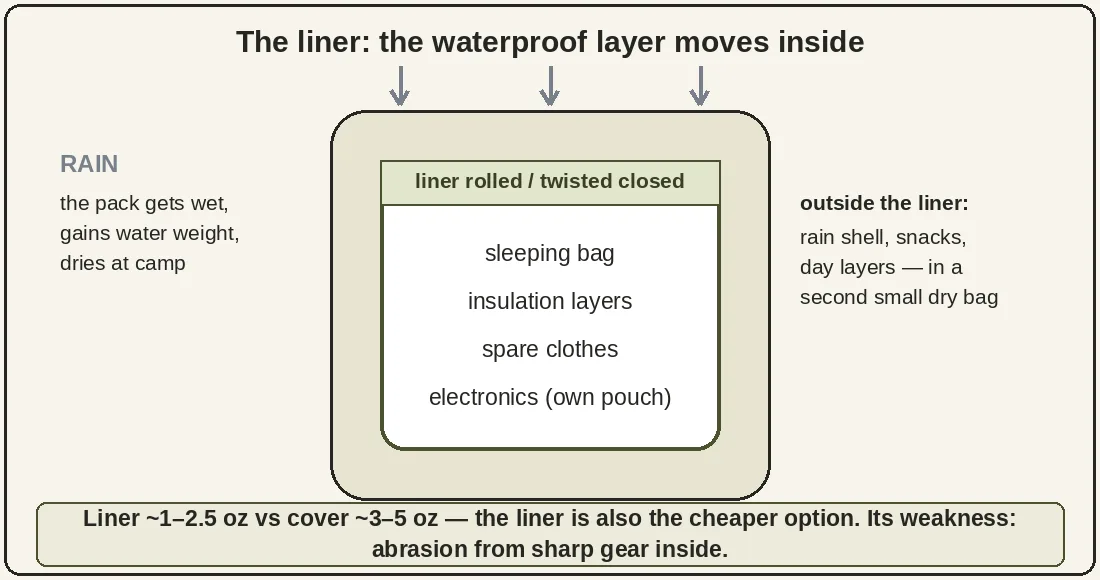
A liner moves the waterproof layer from outside the pack to inside it: a heavy-duty rubble sack or a purpose-made pack liner, rolled or twisted closed at the top, holding everything that must stay dry — sleeping bag, insulation layers, spare clothes, electronics in their own small pouch. Rain can do its worst to the pack; the pack gets wet, gains some water weight, and dries at camp. The gear inside the liner never knows.
| Pack cover | Liner inside the pack | |
|---|---|---|
| Back panel protected? | No — open by design | Yes — gear is wrapped, panel is irrelevant |
| Ponds water? | Yes, on top | No |
| Typical weight | ~3–5 oz | ~1–2.5 oz |
| Failure you notice | Wet gear at camp | A torn sack — swap it at the next town |
The liner is also the cheaper and lighter option, which is not how these comparisons usually run. A contractor-grade rubble sack costs almost nothing and weighs about an ounce or two; even a purpose-made silnylon or DCF liner is a fraction of a good cover’s price. The liner’s honest weakness is abrasion from inside — sharp stove parts and crampon points belong outside it or wrapped — and the fact that gear outside the liner (rain shell, snacks, the day’s layers) still gets wet. Put the day’s working items in a second, smaller dry bag and the system is complete.
When the cover is actually the right answer
Three cases, honestly stated. A pack carrying camera gear or anything that lives in outside pockets all day may need those pockets protected, and a liner cannot reach them. A pack that will sit outside a tent or under a tarp at a wet basecamp collects rain from every direction for hours, and a cover earns its place as a storage shell even if you also use a liner walking. And in sustained, cold, wind-driven rain, some walkers run both — cover to keep the pack fabric itself from absorbing pounds of water, liner as the guarantee. Both together still weigh less than most people’s spare batteries; the argument is only ever about which one you carry if you carry one.
For a bug-out bag specifically, the liner wins without a contest: the bag may sit in a trunk for months, then be carried through whatever weather caused the emergency. A cover packed on the outside degrades, snags, and gets left behind; a liner packed inside is simply part of the bag. It also belongs on the twice-a-year check — see how often should you check and rotate a bug-out bag?
Your next step: weigh the whole rain system, not just the cover
Cover or liner, the decision lands on your back as weight, so make it with the whole pack in front of you. The packs this choice rides on are weighed and compared in best bug-out bags compared, and the Bug-Out Bag Weight Calculator totals the finished system — pack, liner, cover and all — so the rain plan you chose is a number you have actually seen, not a guess made at the gear shelf.
Questions readers ask next
Doesn’t a wet pack weigh a lot more by the end of the day?
Less than people fear. A soaked pack’s fabric and foam might hold a pound or so of water on a genuinely wet day — annoying, not decisive, and it dries overnight at camp. Compare that with the failure the liner prevents: a soaked sleeping bag costs you the night’s insulation, which at 40°F and falling is a safety problem, not a weight problem. Protect the irreplaceable things first; the pack can look after itself.
What about waterproofing the gear in separate dry bags instead?
That works, and for organisation it is better — one bag for sleep kit, one for clothes, one for food. The trade is total weight and total seams: three or four dry bags weigh more than one liner and give water three or four closures to defeat instead of one. Many experienced walkers land on the hybrid: one liner as the guarantee, small dry bags inside it purely as organisers. Either way, the principle is the liner’s — waterproof the gear, not the pack.
Silnylon or silpoly for the pack and tarp — does the fabric choice change this?
Only at the margins. Silnylon sags as it absorbs water, silpoly barely does, and a sagging tarp or a nylon pack shell holding water is a comfort issue — but neither fabric is a waterproofing strategy for the contents. The liner decision stays the same whichever shell you own.
More questions like this: this page is one answer from What People Are Asking About Bug-Out Bags — the full set of bag questions, with the short answers, lives there.
Keep reading
This answer belongs to What People Are Asking About Bug-Out Bags, our hub for the bag questions readers actually type. The packs themselves are scored in best bug-out bags compared, the size question is answered in what size backpack do I need for 3 days?, and total carried weight — where a cover-versus-liner ounce actually shows up — is checked on the Bug-Out Bag Weight Checker.
Talk it over with other readers. The Shelter Tactics Community on Facebook is where readers compare notes on knives, lights, packs, and the rest of the kit — and where your questions help decide what we research next. Join the group →