
Last updated: November 1, 2026
Safety & Communication — Comparison
GMRS Radios Compared: 4 Picks on Specs, Price & Real-World Range
Four handheld GMRS radios scored on evidence, cost, owner experience and fit — for the camp, the convoy and the go-bag. Every one needs the same $35 FCC license; what separates them is power delivery, weather sealing, battery and how much radio you have to learn.
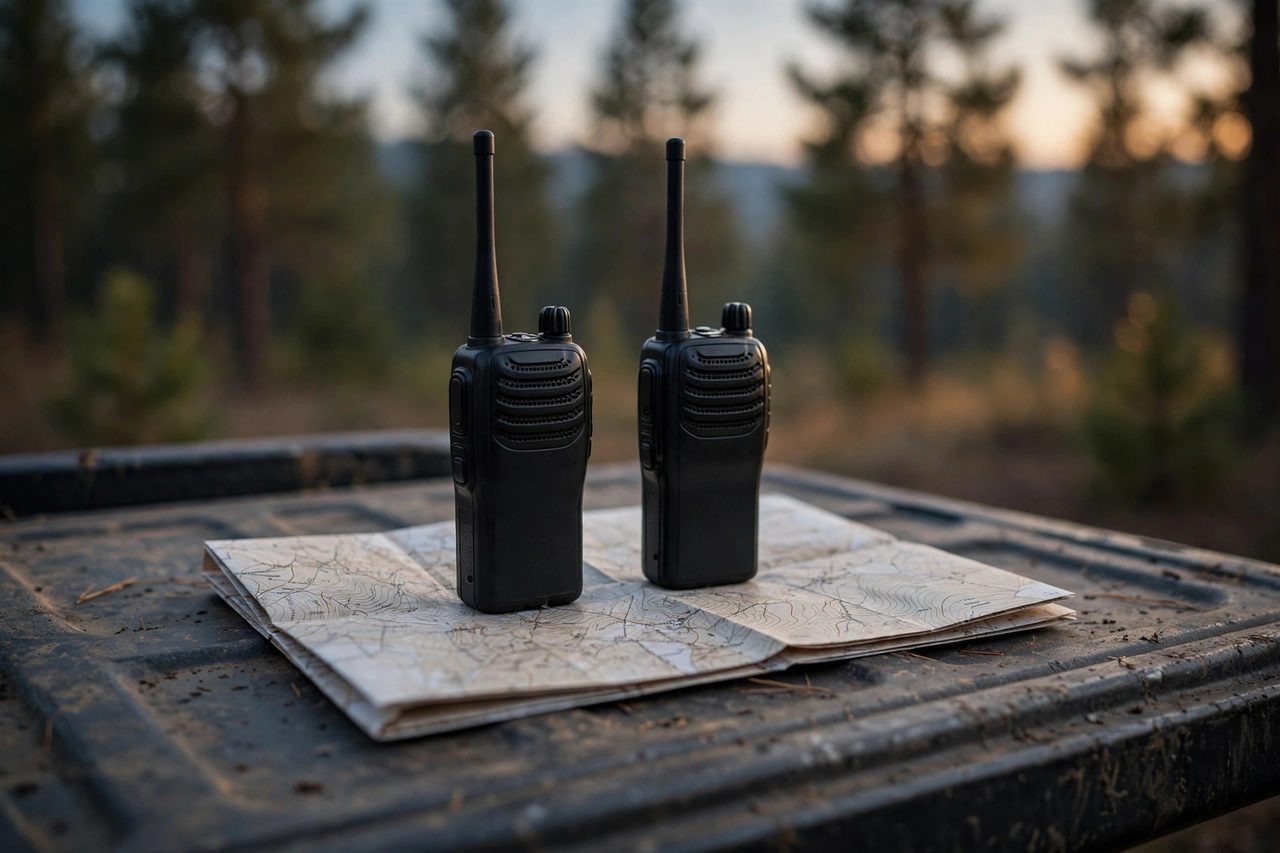
Rocky Talkie Expedition Radio
Score out of 100
BTECH GMRS-PRO
Score out of 100
BTECH GMRS-V2
Score out of 100
Midland GXT1000VP4
Score out of 100
Buying through the links above may earn us a commission at no extra cost to you — and a commission never changes a score. How that works.
The four radios, side by side
| Radio | Power & sealing | Battery & charging | Price, maker’s store |
|---|---|---|---|
| Rocky Talkie Expedition | 5 W · IP67 submersible | 1,800 mAh · 4–6 days | $195 each |
| BTECH GMRS-PRO | 5 W · IP67 submersible | Rechargeable pack · NOAA alerts | $154.89 each |
| BTECH GMRS-V2 | 5 W · IP54 splash | USB-C · 200 channels | $44.89 each |
| Midland GXT1000VP4 | Hi/Med/Lo · JIS4 splash | NiMH packs or 4 AA | $99.99 a pair |
Prices last checked November 1, 2026, at the makers’ own stores — Rocky Talkie, BaoFeng Tech (BTECH) and Midland. Amazon prices move; the buttons above show today’s. One line in this table is doing quiet work: three of these radios can use GMRS repeaters, and the Midland cannot. A repeater on a ridge or a tower is the single biggest range upgrade in this whole comparison, which is why it keeps coming up below.
Rocky Talkie Expedition Radio — 88/100
Verdict: The Expedition is what happens when a radio company deletes almost every feature and spends the money on the shell, the battery and the antenna instead. For a get-home bag or a backcountry group, that trade is the right one more often than not.
The published numbers: 5 watts (the handheld GMRS ceiling), IP67 — submersible to a metre — with a shatterproof screen, a removable antenna with two lengths in the box, and the eight GMRS repeater channels. The specialised 1,800 mAh battery is rated at four to six days per charge and, unusually, that claim is specified to hold in frigid conditions, which is where ordinary radio batteries go to die. Rocky Talkie’s own range table is the most honest in this comparison: 2 to 8 miles in mountains, half a mile to 5 in forest and hills, up to a mile and a half in a city — against the 35-plus line-of-sight figure in the headline.
Owner feedback runs the same direction across the guides and forums we read: the praise is for simplicity and battery life, and the recurring complaint is the price and what the price doesn’t buy — no keypad, no texting, no GPS. Both halves are true. You are paying for a radio a tired, cold person can operate without thinking, and the warranty (three years for personal use) backs the hardware like it’s meant to be kept.
BTECH GMRS-PRO — 86/100
Verdict: The GMRS-PRO is the radio for the group that wants more than voice. It is the only handheld here that can send a text or a location pin to another GMRS-PRO with no cell service anywhere in the loop.
The spec sheet: 5 watts, IP67 submersible, GPS with off-grid location sharing, short text messaging and programming over a Bluetooth link to BTECH’s phone app, NOAA weather radio with alerts, a compass, and a dual-band scanner for listening beyond GMRS. On paper it out-features everything in this post. In practice, owners’ reports split exactly where you’d expect: the location sharing is genuinely useful for split groups, and the app-and-pairing layer is the part that generates the complaints — Bluetooth accessories in particular have a documented history of lag and drops. The one-year warranty (through BaoFengTech) is the shortest cover here.
Buy it when the group will actually use the data features. If nobody is going to open the app, you are paying $110 over the GMRS-V2 for the same voice calls.
BTECH GMRS-V2 — 81/100
Verdict: The value pick, and it isn’t close. At $44.89 the GMRS-V2 undercuts the next radio by seventy dollars while keeping the two things that matter most: full 5-watt transmit power and repeater channels.
What you get: 200 fully programmable channels, repeater support out of the box, dual-band VHF/UHF scanning for listening, an FM radio, NOAA weather reception, IP54 weather resistance and USB-C charging — a charging standard the two premium radios above it don’t all match. Programming runs through the free CHIRP software, which owners consistently describe as the easiest bulk-setup route in this price class.
What you give up: the sealing is splash-grade, not submersible; the speaker and the manual both draw the usual budget-radio complaints; and “fully customisable” cuts both ways — a first-time buyer can mis-set a tone and spend an evening wondering why nobody answers. Our FRS/GMRS settings guide exists for exactly that evening. As a second radio, a loaner, or a first step into GMRS, it is the cheapest full-power handset in this comparison.
Midland GXT1000VP4 — 79/100
Verdict: The family kit. Two radios, two boom-mic headsets, rechargeable packs, AA backup, a desktop charger and car adapter for $99.99 the pair — priced per working radio, it is the cheapest way in this post to put a handset in two people’s hands.
The honest limits, all from Midland’s own material: the GXT1000 has no repeater channels, so its range is its range — and Midland’s FAQ puts that at half a mile to two miles in normal conditions, against the “up to 36 miles” on the packaging. The sealing is JIS4, splash resistance, not submersion. Power is selectable high/medium/low rather than a published wattage. The 50 channels (22 GMRS plus 28 preset extras) and 142 privacy codes are plenty for family use, and the NOAA alert radio is a real inclusion at this price.
Owners buy it for exactly what it is — property, camp and caravan duty — and the complaints cluster on the gap between the box’s range claim and the street’s reality. Read the range section below before you judge any of these radios, this one most of all.
What “range” actually means on all four
Every box in this comparison leads with a number measured from a mountaintop to a boat. Radios don’t fail by distance; they fail by obstruction — a ridge, a building, a wet forest between you and the other handset. The realistic planning numbers: a 5-watt handheld reaches one to three miles in typical terrain, more with elevation, and tens of miles through a repeater that can see you both. That is the whole reason repeater support keeps deciding scores here, and why the calculator matters more than the brochure: run your own terrain through the range math before you spend anything.
The license, once, in plain terms
Transmitting on GMRS needs an FCC license: $35, ten years, no exam, and one license covers your immediate family. Listening needs nothing. The full walk-through — the FCC’s two systems, the order to do them in, and what the license unlocks — is in our GMRS license guide. Once you’re licensed, getting on a repeater is a settings exercise, not a second purchase.
Questions people ask about GMRS radios
Do I need a license for these radios?
To transmit, yes — the $35 GMRS license above. There is no test, and it covers your immediate family for ten years. Receiving and listening are free for anyone, which is why a scanner-minded radio like the GMRS-V2 is useful even in unlicensed hands.
Can a GMRS radio talk to cheap FRS walkie-talkies?
Yes — GMRS and FRS share channels, with power and antenna rules deciding which side of the conversation each radio is on. The settings that have to match, and the two things a GMRS radio cannot do to an FRS set, are laid out in our FRS/GMRS guide.
How far will these radios really reach?
Plan on one to three miles handheld-to-handheld in ordinary terrain, less in a city, more from high ground — and an order of magnitude more through a repeater. Anyone quoting you 30-plus miles is quoting a mountaintop. The terrain-by-terrain breakdown lives with the range calculator.
Which of these belongs in a get-home bag?
The Expedition, on battery and simplicity: it is the one most likely to work on day four, operated by a tired person wearing gloves. The GMRS-V2 is the budget answer to the same question, with setup homework accepted. Our gear-ready checklist carries the rest of the bag.
More questions, answered one by one: what people are asking about GMRS radios.
Compare notes with other gear carriers
The Shelter Tactics Community on Facebook is where readers show their kits, ask what actually holds up, and help decide what we test next.