Last updated: October 31, 2026
Affiliate Disclosure: Shelter Tactics is reader-supported. When you buy through links on this page, we may earn a commission at no extra cost to you. As an Amazon Associate, Shelter Tactics earns from qualifying purchases. Learn more.
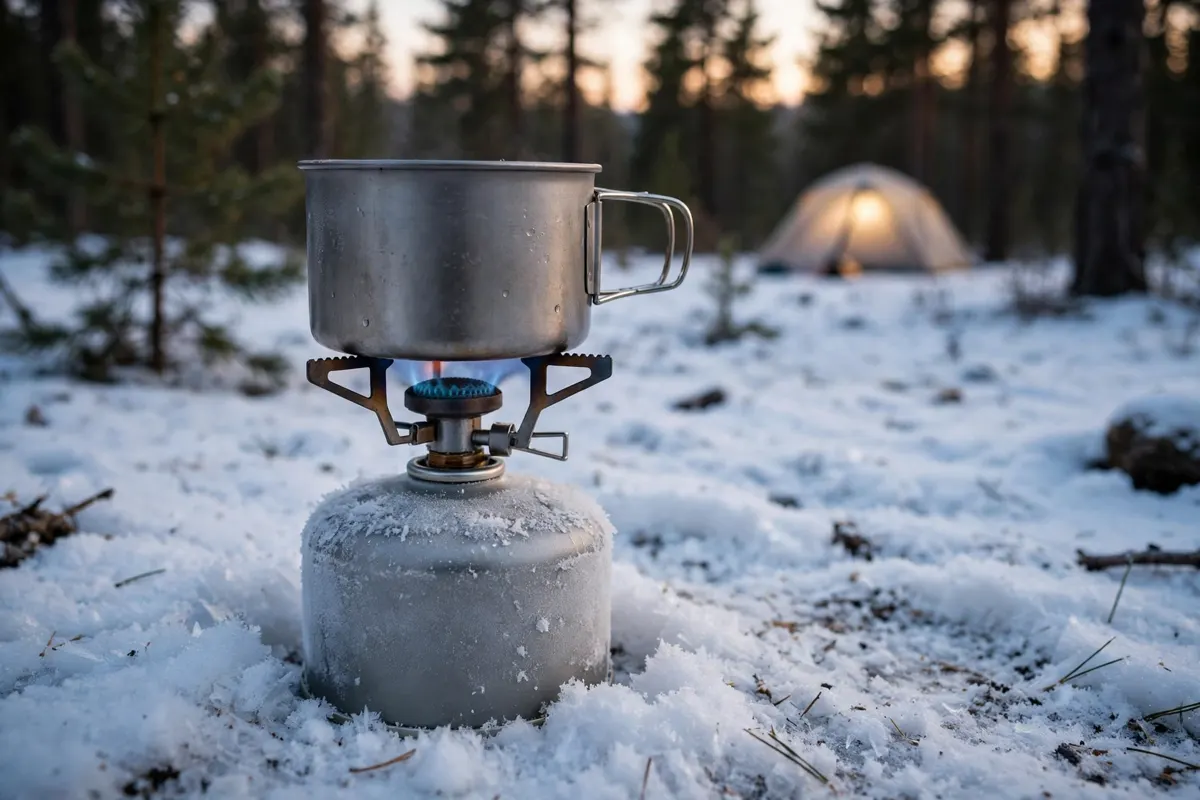
The short answer: A canister stove dies in cold weather because its fuel stops turning into gas. Standard canister fuel is mostly butane or isobutane, and butane stops vaporizing at about 31°F while isobutane stops at about 11°F — and the act of burning chills the canister further, often well below the air temperature, so the flame fades even on a morning that does not feel that cold.
What is actually inside the canister
A backpacking canister holds liquid fuel under pressure, not gas. Open the valve and a little of that liquid boils off the top as vapor, travels up to the burner, and burns. The stove runs on vapor pressure, and vapor pressure is set by temperature and by which fuel is in the blend.
The three fuels behave very differently. Plain butane, the cheap half of most blends, has a boiling point of about 31°F (-0.5°C). Isobutane, its chemical cousin, keeps vaporizing down to about 11°F (-12°C). Propane keeps going to about -44°F (-42°C). That is why the better canisters — MSR IsoPro and Jetboil JetPower are both an 80/20 blend of isobutane and propane — skip plain butane where they can: the isobutane carries the cold performance and the 20% propane supplies pressure.
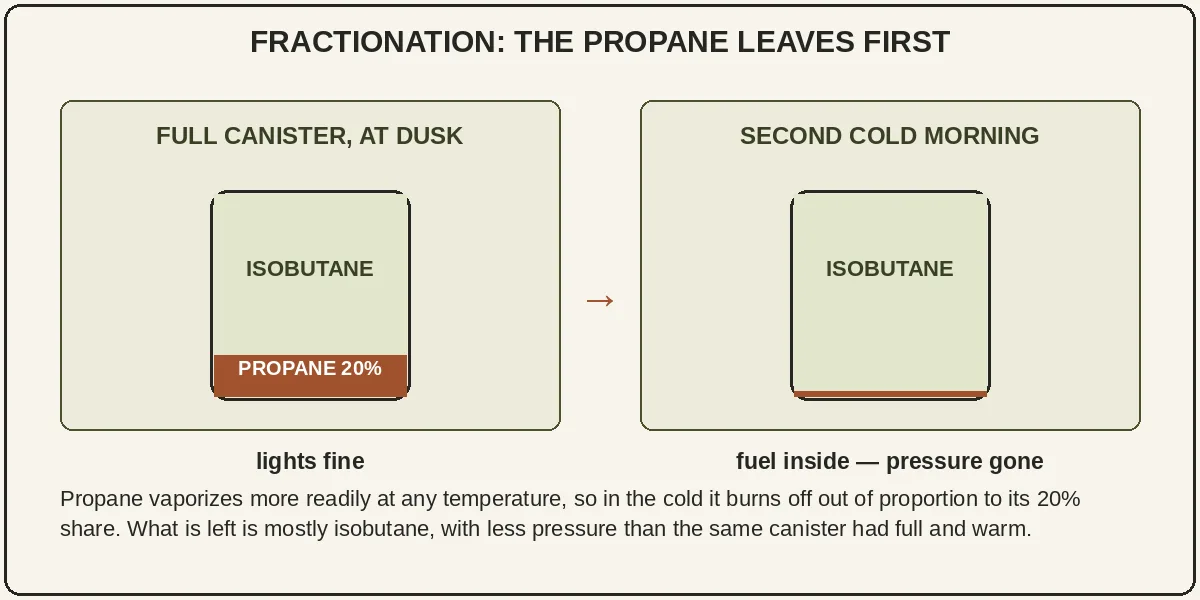
There is a catch built into the blend. Propane vaporizes more readily than isobutane at any given temperature, so in the cold it burns off first, out of proportion to its 20% share. Stove writers call this fractionation. A canister that lit fine at dusk can be mostly isobutane by the second cold morning, with less pressure than the same canister had when it was full and warm. The fuel is still in there. It just will not come out as gas.
The second problem: the stove chills its own fuel
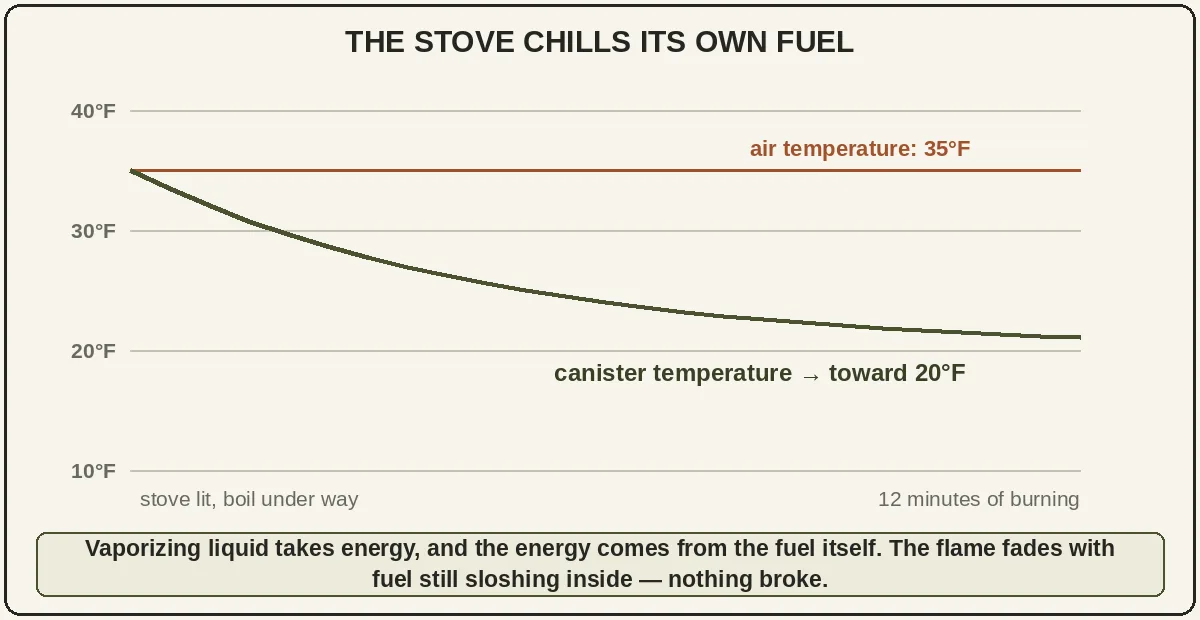
Vaporizing liquid into gas takes energy, and inside a canister that energy comes from the fuel itself. Every minute the stove runs, the canister gets colder — noticeably cold to the touch in summer, and in winter cold enough to drop well below the air around it. A canister that starts a boil at 35°F air temperature can cool itself toward 20°F while the water heats, crossing the line where its own blend stops producing useful pressure.
That self-chilling explains the pattern owners describe in winter threads year after year: the stove lights strong, boils half a pot, then shrinks to a candle flame and dies, with fuel still sloshing inside. Nothing broke. The canister simply refrigerated itself below the point where the remaining fuel — by then short on propane — could push gas to the burner. Long boils and melting snow make it worse, because the stove runs longer and the canister has more time to chill.
A regulator helps with the symptom, not the cause. A regulated stove meters gas to hold output steady as pressure falls, so it keeps a usable flame deeper into a cold, half-empty canister. It cannot create pressure that is not there. Once the fuel itself is too cold to vaporize, a regulated upright stove fades too — it just fades later and more gracefully.
At what temperature does each kind of stove quit?
| Air temperature | What happens | What still works |
|---|---|---|
| Above 40°F | Full pressure, normal boils | Any canister stove |
| 32–40°F | Unregulated stoves fade late in a boil | Regulated upright; all else |
| 20–32°F | Plain butane blends stop; self-chilling bites | Regulated upright, briefly; inverted remote |
| 10–20°F | Upright vapor-feed is unreliable | Inverted remote; liquid-fuel |
| 0–10°F | Upright stoves are done | Inverted remote, warmed can; liquid-fuel |
| Below 0°F | Canister pressure is marginal at best | Liquid-fuel, reliably |
Read the middle column as the physics and the right column as the shopping list. Upright unregulated stoves — the MSR PocketRocket 2 class — are three-season stoves that tolerate a frosty morning if the canister starts warm. A regulated upright buys roughly another band of cold. Remote stoves that run the canister upside down gain about 20°F over an upright, because liquid fuel leaves the canister and vaporizes in a preheat tube at the burner instead of inside the can. Liquid-fuel stoves sidestep the whole problem: you pump the bottle up by hand and the fuel vaporizes in a hot generator tube, so ambient temperature barely matters.
One honest wrinkle: those bands assume the canister itself is at air temperature. A canister slept with, or sitting in liquid water, performs a band or two better than the thermometer suggests. A canister left on snow through a long boil performs a band worse. The canister’s temperature is the number that counts, not the forecast.
The fixes, ranked by how much cold they actually buy
1. Warm the canister — free, and good for a band or two. Sleep with the canister in your bag, carry it in an inside pocket on the hike in, and swap a cold can for a warm one mid-boil if you carry two. The field trick with the best physics behind it is the water bath: set the canister in a shallow bowl or lid of liquid water while it runs. Liquid water cannot be below 32°F, so the bath holds the canister at or above freezing and replaces the heat that vaporization steals. A chemical hand warmer taped to the canister’s side does a smaller version of the same job.
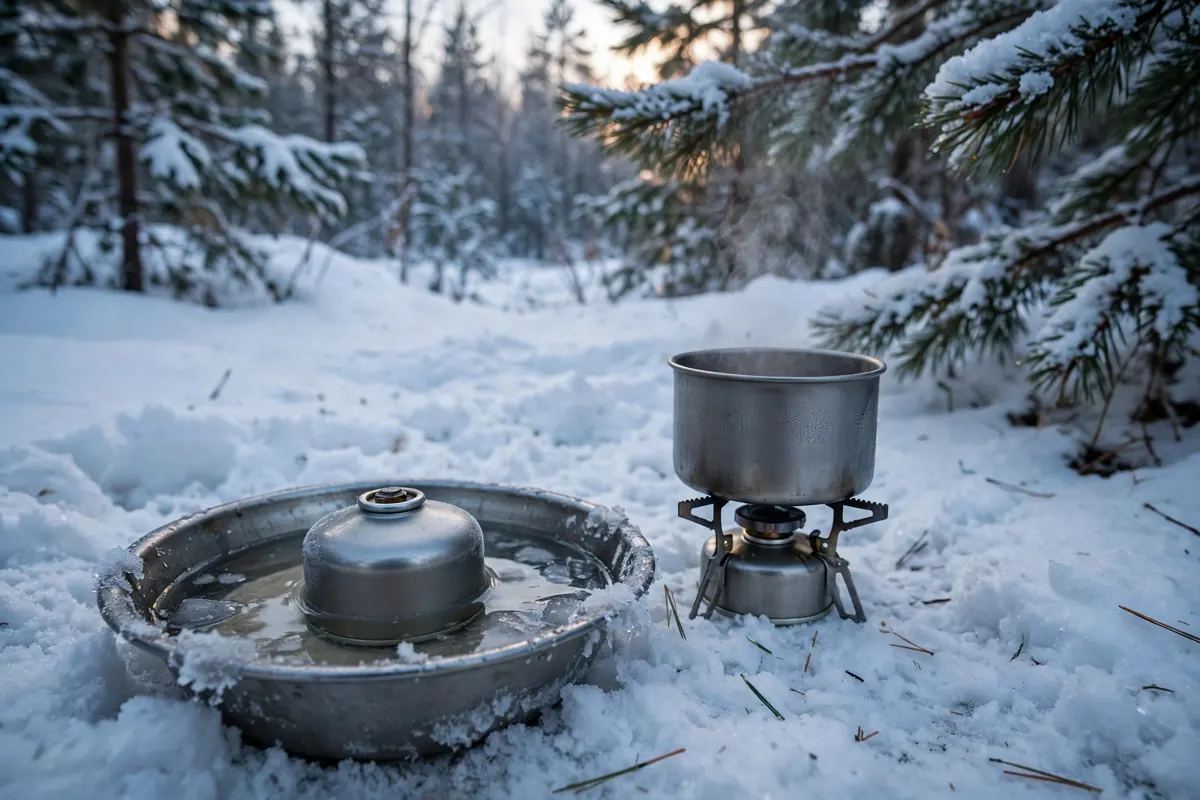
The safety line for all of this: warm a canister with body heat, water, or a hand warmer only — never with the stove’s flame, a fire, or reflected heat from a full windscreen wrapped around it, and never past comfortable to hold in a bare hand (about 104°F). An overheated canister is a pressure vessel problem, not a performance tip.
2. Buy a regulated upright stove — the fix that stays in the three-season kit. Of the four stoves in our camp stoves comparison, only one is regulated, and it is the one that kept its output in cold and wind testing while the unregulated stoves faded. A regulator does not repeal the vaporization limits above, but for shoulder-season trips — frosty mornings, cold rain, a canister near empty — it is the difference between a slow boil and no boil.
3. Go remote and inverted — the real canister answer for winter. A remote stove sits on its own legs, connected to the canister by a hose, with a preheat tube running through the flame. Upright, it behaves like any vapor-feed stove. Flip the canister over on its stand and liquid fuel flows to the burner, where the flame’s own heat vaporizes it. The blend no longer fractionates, the canister no longer self-chills, and the practical floor drops to around 0°F and, with a warmed start, below it. The MSR WindPro II and the Kovea Spider are the two names that come up most in this class. We hold no affiliate link for either, so they are named here as the category answer, not as picks — expect remote stoves to weigh two to three times what an upright weighs, which is the honest price of the hose, legs, and preheat loop.
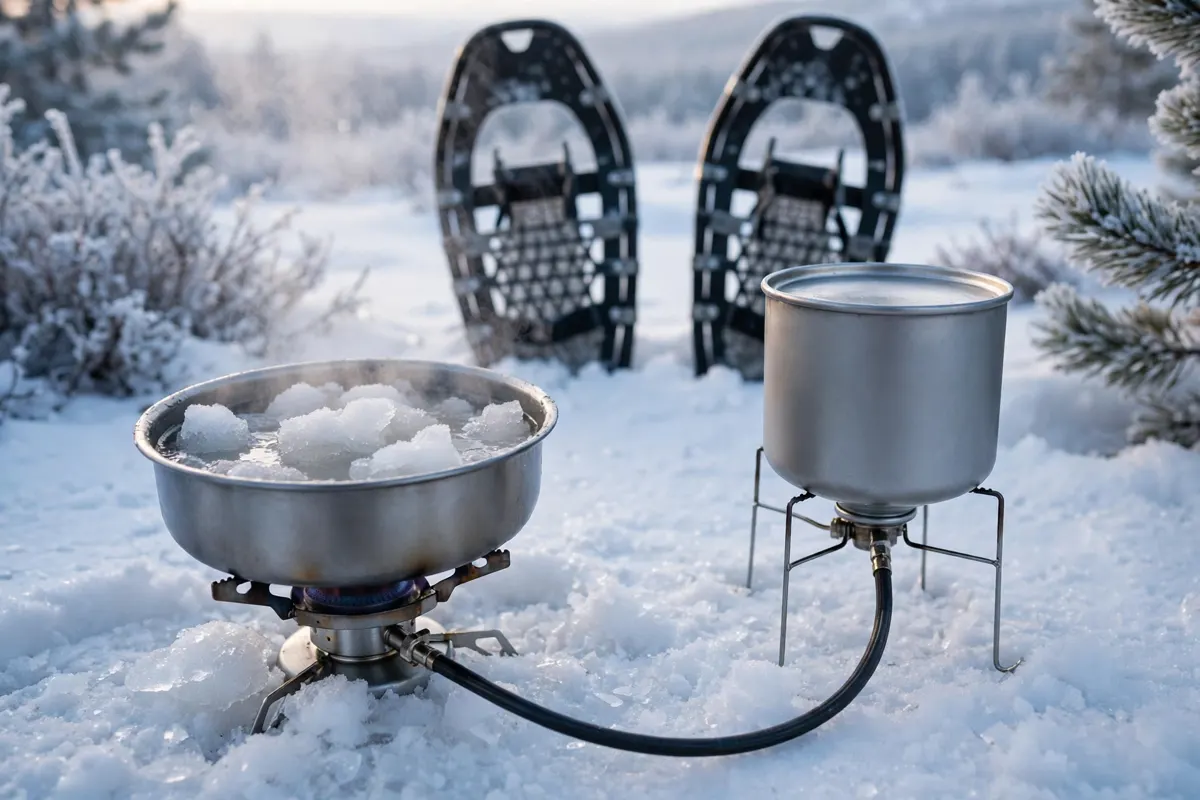
4. Burn liquid fuel — the answer below about 0°F. A white-gas stove of the MSR WhisperLite class carries its pressure in a pumped bottle, not in vapor pressure, and vaporizes fuel in a tube the priming flame heats. Cold that ends every canister stove’s day is a non-event for it, and liquid fuel is cheaper per boil on long winter trips where you are melting snow for hours. The costs are weight, priming, and maintenance. Below 0°F, or on any trip where a dead stove means no water, those costs are the correct trade.
SOTO WindMaster
MSR PocketRocket 2
Put in the terms of our comparison: the SOTO WindMaster at $69.95 is the upright stove to own if your season includes cold mornings, because the regulator is doing real work every time pressure falls. The MSR PocketRocket 2 at $49.95 remains the honest default above freezing — lighter in its case, a decade of thru-hikes behind it — and this page is the boundary of what it should be asked to do. Neither upright changes the table above: sustained winter cold wants an inverted remote stove or liquid fuel, not a better upright.
Questions readers ask next
How much stove fuel do I need per day?
Fuel per day is arithmetic once you know your stove’s grams per liter: about 10 grams per liter for a Jetboil Flash, about 14 for a typical upright in calm air, and roughly double in wind and cold. A solo freeze-dried menu runs about 2 liters a day. Full worked tables are on our fuel-per-day page.
How much fuel is left in my canister?
Weigh the canister and subtract the empty weight stamped on its base. What remains is fuel; divide by your stove’s grams per liter — about 14 for an upright — and you have liters of boils left. Shaking and sloshing tell you a canister is not empty; only the scale tells you whether it holds one boil or six.
Why does my piezo igniter fail at altitude?
Piezo igniters spark weakly in thin air; Jetboil’s guidance puts the failure zone at about 7,000 feet and up. The fuel-air mix at the burner is leaner and the spark has less density to jump through, so clicks produce no flame. Carry a lighter or storm matches up high — two stoves in our comparison have no igniter.
Can I fly with a camp stove?
The stove itself can fly, cleaned and aired out until no fuel smell remains, in checked or carry-on baggage under current TSA and FAA rules. Fuel canisters can never fly in either bag, full or empty — the rule has no partially-used exception. Buy a canister at your destination, and leave the home supply problem behind you.
More questions like this: this page is one answer from What People Are Asking About Stoves and Fuel — the full set of stove and fuel questions, with the short answers, lives there.
Keep reading
This answer belongs to What People Are Asking About Stoves and Fuel, our hub for the stove and fuel questions readers actually type. The stoves named here live in our Fire & Cooking hub; the four-stove dataset behind the pick cards is our camp stoves compared guide, and the pots those burners deserve are in our cook kits compared guide. The companion fuel-math page — grams per day, per trip, and per canister size — is how much stove fuel do I need per day?
Prices last checked: October 26, 2026 — carried from our camp stoves comparison, where each price was verified that morning.
Talk it over with other readers. The Shelter Tactics Community on Facebook is where readers compare notes on knives, lights, packs, and the rest of the kit — and where your questions help decide what we research next. Join the group →