
Two numbers sell every two-way radio: the miles on the box and the hours on the box. Both are honest numbers — measured under conditions you will never meet. A range claim assumes high antennas and nothing in between. A battery claim assumes you barely talk. This page runs the same math under your conditions instead: your antenna height, your ground, and a day of radio use that looks like yours.
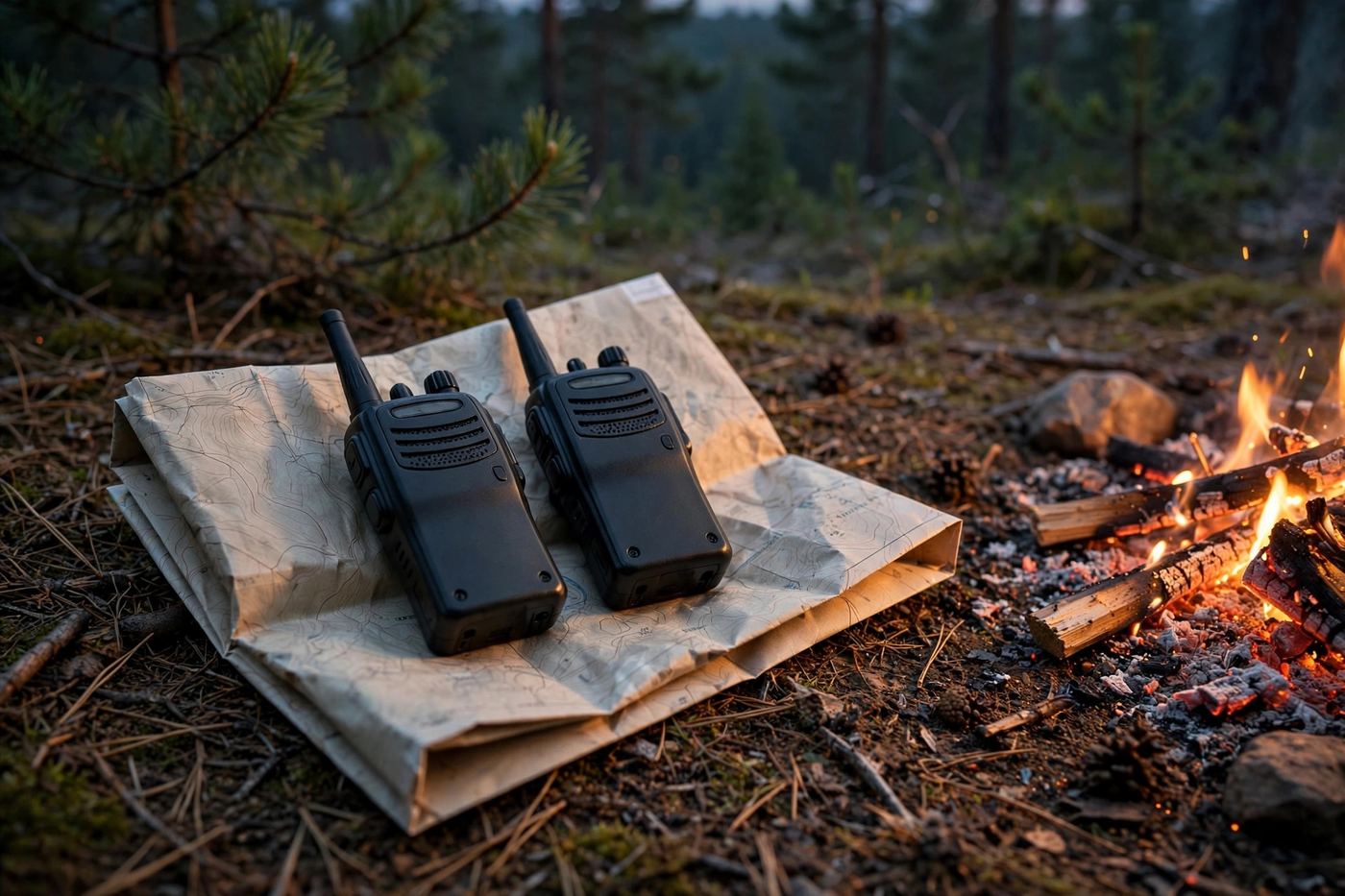
Why is my ‘35-mile’ GMRS radio only reaching about a mile in the woods?
Because the 35 miles on the box and the mile you’re getting are both real — they’re just measured in different worlds.
The number on the packaging is a best-case figure: two radios with a clear, unobstructed line of sight between them, the way you’d get standing on one ridge talking to another, or across open water. Nothing between the antennas but air. Midland — the brand that prints some of the biggest numbers on its boxes — says in its own FAQ that in normal conditions you should expect about a half-mile to two miles. The box number isn’t a lie so much as a weather report for a planet with no trees on it.
Trees are the problem in your woods, and they’re a bigger one than most people expect. GMRS runs on UHF, and UHF does not bend around terrain or pass through wet foliage well. Every trunk and leafy canopy between you and the other radio absorbs some of the signal, hills block it outright, and a handheld held at chest height puts the antenna down in the thickest part of it. A mile in thick woods is not a broken radio — for a 5-watt handheld, it’s an ordinary result. Rocky Talkie’s own range table for its 5-watt Expedition tells the same story: two to eight miles in the mountains, half a mile to five in forest, a mile and a half or less in a city.
Three things actually move the number:
- Height. Getting the antenna up — a ridge, a clearing, even holding the radio overhead for a call — does more than any other change. Range is mostly a line-of-sight problem.
- A repeater. A repeater on high ground hears your signal and rebroadcasts it from up where the view is clear, which turns your one wooded mile into coverage across the whole area the repeater can see. Our guide to getting on a GMRS repeater walks through finding one and using it properly.
- A better antenna position, not more advertised watts. You’re already at the 5-watt handheld limit. The gap between the box number and your woods was never about power.
That’s exactly what the calculator below is for: pick your radio and your terrain and it will show you the honest number before you’re standing in the woods counting on the one on the box. If you’ve settled on GMRS, our GMRS radios comparison scores four handhelds on specs, price and real-world range — and if you haven’t got the license yet, it’s $35, no test, and our license explainer walks it through.
How far will it really reach?
Radio signals at these frequencies travel in straight lines, so the curve of the earth itself sets the limit — engineers call it the radio horizon, and no wattage changes it. Tell the calculator what the box promised and where the two antennas actually sit.
—
—
—
Notice what is not an input above: watts. Going from a half-watt radio to a 5-watt radio — ten times the power — adds no distance at all to that ceiling. Extra power helps a weak signal punch through trees and clutter near the edge of range, and that matters. But the ceiling itself moves only when an antenna goes up. Raising one handheld onto a two-story roof adds about 4 miles. That is the trade the box numbers never mention.
How long will the battery really last?
Every battery-life claim in this industry is measured the same quiet way: the radio spends 5% of its time transmitting, 5% receiving, and 90% sitting idle — the 5/5/90 standard, printed right in the manuals. A morning of calling in a hunting party or keeping a work crew together looks nothing like that. Pick your radio, then pick your day.
—
—
—
Two habits stretch a battery further than any setting. Talk on low power when the other radio is close — the radio draws several times more power at full watts, and close range does not need them. And treat the last fifth of the battery as your reserve, the same way you treat the last of a fuel can: the plan below already holds that reserve back.
Worked example: the starting numbers — a “36-mile” range printed on the box, a handheld antenna at each end (5 ft), and rolling hills in between — come out at about 2.5 to 4.5 miles of real range, against a physics ceiling of 6.5 miles for those antenna heights. The battery half starts on the Wouxun preset and a quiet day: about 15.6 hours per charge.
Talk time: the day decides, not the battery
Hours per charge for the Wouxun KG-935G Plus preset (5.5 watts, 2,600 mAh), worked with this page’s own battery model — the quiet-day figure is the section’s worked example.
Talk on low power when the other radio is close: the radio draws several times more at full watts, and close range does not need them.
What actually buys range
| Change | What it gets you |
|---|---|
| More power (0.5 W → 5 W) | No extra miles of reach. A stronger signal through trees, buildings, and weak spots near the edge of range. |
| One antenna from 5 ft to 25 ft | About 4 more miles of ceiling — the cheapest range there is. |
| A repeater 300 ft up | Lifts a 6-mile ceiling to roughly 28 miles. This is where the big box numbers come from. |
| Stepping out from behind a ridge | The difference between nothing and a clear conversation. A hill in the path beats any radio. |
The fine print
The range ceiling uses the standard radio-horizon formula — 1.41 times the square roots of the two antenna heights in feet, added together — which already credits the atmosphere for bending signals slightly. The terrain bands are planning estimates drawn from retailer and field guides: open ground keeps 80–100% of the ceiling, rolling hills 40–70%, dense forest 25–45%, and town buildings 10–30%. A ridge squarely between two radios can take the real number to zero whatever the table says. Treat every result as a planning band, not a promise.
The battery math works in watts. A radio transmitting at full power draws roughly twice its rated watts plus a watt for the radio itself — a 5-watt handheld really pulls about 11 watts while you hold the button. Listening draws about 1.8 watts, and idle with the battery saver on about 0.4. The calculator holds back 15% of the pack as a reserve you should never plan to spend.
One rule worth knowing before you buy: GMRS radios need an FCC license to transmit on their full-power channels. It costs $35, there is no test, it covers your whole immediate family, and it lasts 10 years. The license-free FRS channels work in these same radios at lower power. Every radio this site features is an FCC-certified GMRS model — that is the only kind we will ever point you at. Radios are one section of the Gear-Ready Emergency Checklist — the full grab-and-go list this page’s numbers feed into.
Questions people ask
Why does the box say 36 miles? Because somewhere — a hilltop repeater, a signal crossing open water — that number has happened. It assumes at least one antenna hundreds of feet up and a clear path the whole way. At head height on ordinary ground, physics caps any handheld near 6 miles before terrain takes its cut.
Does a 5-watt radio reach farther than a 2-watt radio? Not farther in distance — the earth’s curve sets that limit for both. The 5-watt radio sounds clearer at the same distance and holds on better through trees and clutter, which is a real advantage. It is just not the advantage the box is selling.
How long does a GMRS battery last on a hunting trip? On the quiet pattern the industry rates by, a good 5-watt handheld with a 2,600 mAh pack runs about 15 hours. Coordinate a drive all morning and the same radio is closer to 5. The calculator above runs your own mix — that spread is why the honest answer is always “it depends how much you talk.”
Radios that fit this math
These are three of the four radios scored in our GMRS radios comparison — the premium pick, the famous pair, and the tinkerer's radio, bracketing the market this calculator describes — the premium pick, the famous pair, and the tinkerer's radio:
Rocky Talkie Expedition Radio
The backcountry favorite: a full 5 watts, IP67 waterproofing, and a battery measured in days, not hours.
Midland GXT1000VP4
The famous pair from this page's math — the 36-mile box claim, two radios in the box, the value pick.
BTECH GMRS-V2
The tinkerer's radio: repeater-ready with a removable antenna, at a price the other two are not.
As an Amazon Associate, Shelter Tactics earns from qualifying purchases. It never changes a score or a number on this page. GMRS use needs an FCC license — $35, no exam, covers your household.