Last updated: November 1, 2026
Affiliate Disclosure: Shelter Tactics is reader-supported. When you buy through links on this page, we may earn a commission at no extra cost to you. As an Amazon Associate, Shelter Tactics earns from qualifying purchases. Learn more.
The short answer: Counted honestly, as full sleep systems, they land within a few ounces of each other — a complete three-season hammock system (hammock, straps, tarp, underquilt, top quilt) in mid-weight gear totals about 6.5 pounds, and a comparable tent system (tent, pad, sleeping bag) totals about the same — and in ultralight builds both land around 4 to 5 pounds. The hammock only wins if you were going to carry a quilt anyway; the tent only wins if your pad does double duty. Anyone quoting you a 19-ounce hammock against a 3-pound tent is weighing half of one system against all of the other.
The comparison everyone gets wrong
The r/Ultralight argument that never dies starts with a false pairing: a hammock’s body weight set against a tent’s whole weight. Our own hammock comparison shows why that misleads. The ENO DoubleNest’s hammock body is 19 oz — and with its straps, testers measured 31 oz as actually carried. The budget Wise Owl kit, straps and carabiners in the bag, measured 30 oz all-in. And neither figure includes a tarp for rain or insulation for underneath, without which a hammock is a lounge, not a shelter. A hammock is not a sleep system. Neither is a tent: it still needs a pad and a bag inside it. Systems are the only honest unit.
Both systems, weighed all-in
| Piece | Hammock system | Tent system |
|---|---|---|
| Shelter body | Hammock + straps: ~30 oz | 2-person backpacking tent: ~48 oz |
| Rain cover | Tarp (DD 3×3 class): ~28 oz | Included in the tent |
| Insulation below | Underquilt, 20°F class: ~22 oz | Pad, R 4–5 class: ~14–20 oz |
| Insulation above | Top quilt, 20°F class: ~26 oz | Sleeping bag, 20°F class: ~40 oz |
| All-in total | ~106 oz (6.6 lb) mid-weight build; ~4–4.5 lb in ultralight builds | ~102–108 oz (6.4–6.8 lb) mid-weight build; ~4–5 lb in ultralight builds |
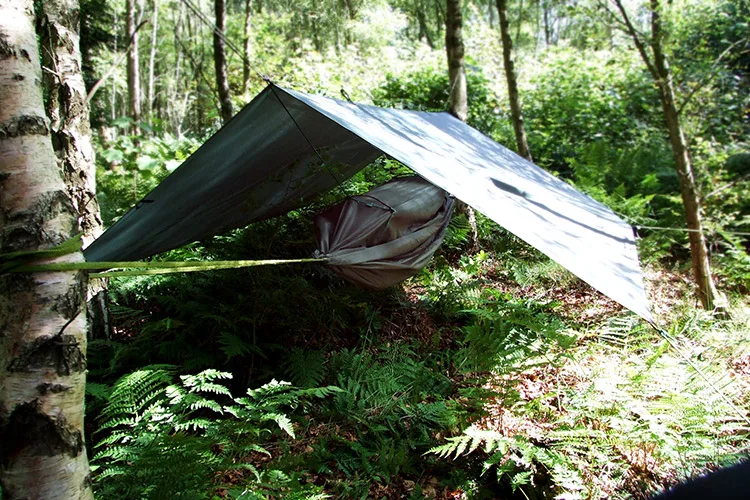
The hammock column is anchored on this site’s own measured figures: the 30 oz all-in hammock kits from hammocks compared and the 790 g (about 28 oz) DD Tarp 3×3 from tarps compared. The underquilt and top-quilt rows are typical published weights for 20°F-class quilts. The tent column uses typical published weights for the classes named. Read the totals, not the rows: the systems converge. Where they diverge is in which pieces you already own and which pieces do other jobs — a pad also works on the ground when there are no trees; a tarp also pitches as a standalone shelter; a sleeping bag also works in a hammock as a top layer, awkwardly.
Ultralight builds pull both totals down by the same moves: a lighter tarp (the DD SuperLight is 490 g, about 17 oz) on the hammock side; a lighter tent and a foam pad on the other. Neither system has a structural weight advantage worth arguing about. Both have a lighter build available to anyone willing to pay for it, which is the real content of most of those forum threads.
So decide it on the things that actually differ
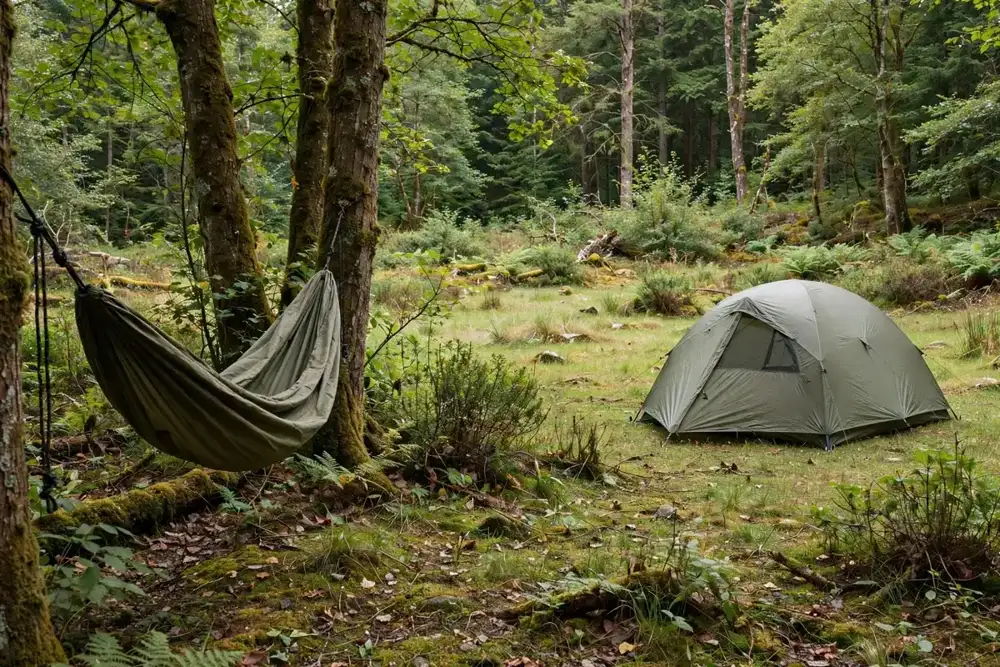
Ground and trees decide more trips than ounces do. A hammock needs two suitable trees roughly 12 to 15 feet apart at every camp — trivial in eastern forest, impossible above treeline, in deserts, and in many organised campgrounds. A tent needs a patch of ground flat enough to lie on, which exists almost everywhere people camp, including places where the ground is wet, rocky, or shared with a partner who also wants shelter. Two people change the maths hardest: a tent sleeps two in one system, while two hammock sleepers carry two complete hammock systems — the tent’s per-person weight halves, the hammock’s does not.
Comfort is the other real difference, and it is personal rather than measurable: many back and side sleepers genuinely sleep better suspended, with no pressure points and no pad sliding out from under them; others never get the diagonal lay right and sleep badly all night, every night. That is a try-before-you-commit question — one borrowed night in a hammock answers it better than any table, including ours.
Questions readers ask next
Do I need an underquilt, or will a sleeping pad inside the hammock work?
A pad works, and it is the cheaper start: it insulates underneath, it is already in your kit if you own one, and in mild weather it is enough. Its costs are feel and fuss — the pad shifts, bunches, and slides as you move, and its edges leave your shoulders and hips against cold air. An underquilt hangs below the hammock, lofts uncompressed, and stays put; below about 50°F most hammock sleepers who try both keep the underquilt. The weight difference is small; the sleep difference is the product.
How do I stop rain running down my hammock straps?
Tie a short drip line around each strap just inside the tarp’s edge and let the ends hang — water tracking along the webbing transfers to the cord and drips off instead of continuing into the hammock. It is a two-minute, two-scrap fix, and it has its own full answer: how do I stop rain running down my hammock straps?
Are quilts for side sleepers?
Yes, in a wide cut — about 55 inches or more — with pad straps used. Side sleepers are the quilt’s hardest test and, in the right width, its best customers. The full answer is at are quilts for side sleepers?
More questions like this: this page is one answer from What People Are Asking About Sleep Systems — the full set of sleep-system questions, with the short answers, lives there.
Keep reading
This answer belongs to What People Are Asking About Sleep Systems, our hub for the sleep questions readers actually type. Its parts are compared in hammocks compared and tarps compared, its warmth is modelled on the Sleep System Temperature Calculator, and its ground-side rival’s key number is answered in what R-value do I need for 20°F?
Talk it over with other readers. The Shelter Tactics Community on Facebook is where readers compare notes on knives, lights, packs, and the rest of the kit — and where your questions help decide what we research next. Join the group →