Tarps Compared: 4 Picks on Specs, Price & Owner Feedback
If you buy one tarp for camp and bug-out duty, buy the DD Tarp 3×3 — 19 tie-outs, pegs and guy lines in the bag, and a decade of bushcraft schools beating on it. If the tarp has to survive days pitched in bad weather, the AquaQuest Defender 10×10 carries a 20,000mm coating and a lifetime warranty — and you pay for both in carry weight.
Last updated: October 30, 2026 Affiliate Disclosure: Shelter Tactics is reader-supported. When you buy through links on this page, we may earn a commission at no extra cost to you. Learn more.
How we researched this comparison: We scored 4 products on evidence (30), cost of ownership (25), owner experience (25) and preparedness fit (20), using makers’ published specifications and patterns in verified owners’ reports. Prices on this page were last checked October 27, 2026. How We Rate.
87/100
Top score — DD Tarp 3×3
$69.95
Lowest price in the field — DD Tarp 3×3; prices last checked October 27, 2026
490 g
Lightest tarp — DD SuperLight, tarp only; pegs and lines still in the box
4
Tarps scored on the same four measures — evidence, cost, owners, fit
THE SHORT VERSION — SCORES OUT OF 100
Best all-round
DD Tarp 3×3
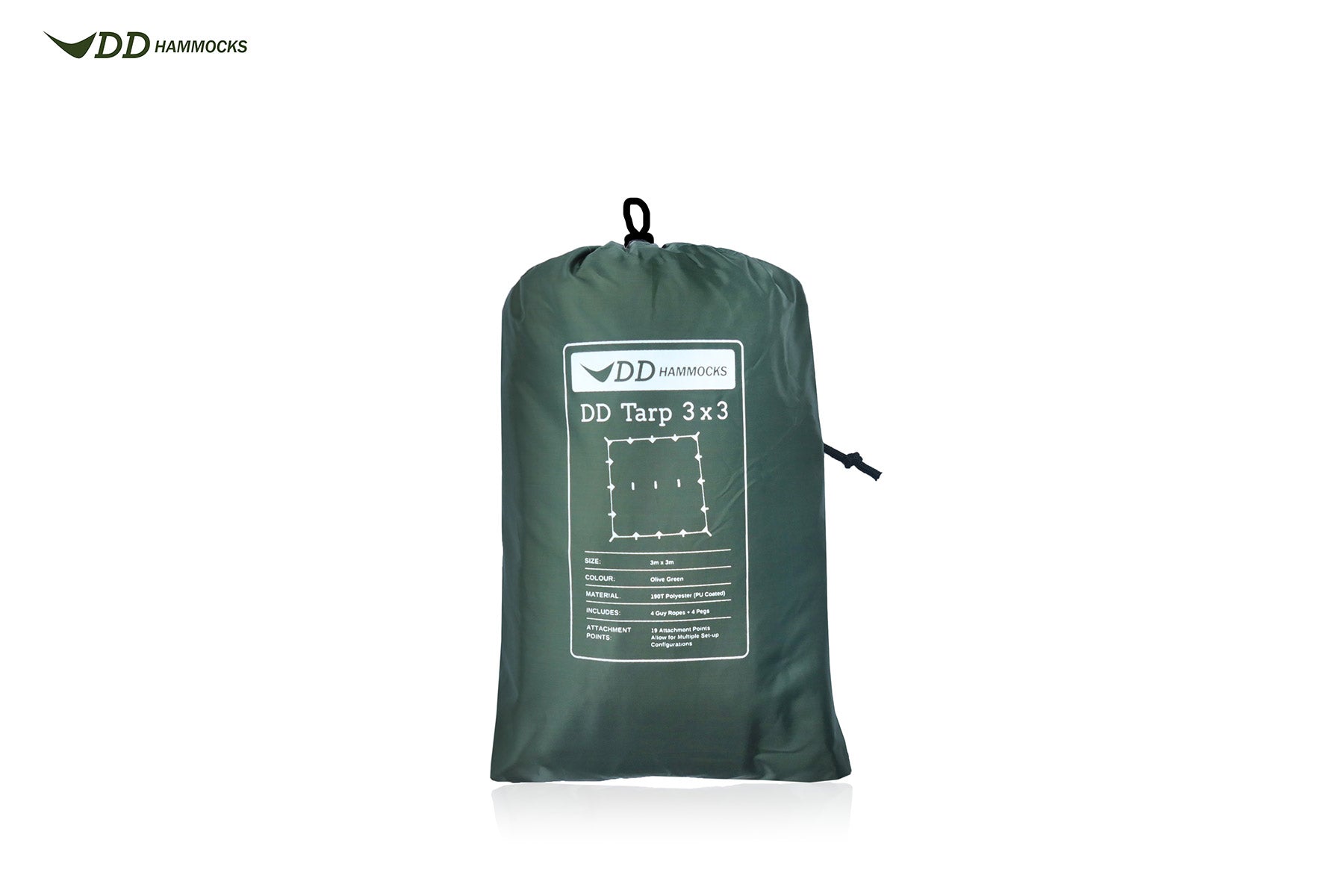
Photo: DD Hammocks.
87/100 (8.7/10)
$69.95
87
Score out of 100
The bushcraft standard: 19 tie-outs, a full kit in the bag, and 790 grams of polyester that shrugs off rough pitches.
A 20,000mm TPU coating, heat-taped seams and a lifetime warranty — the tarp you pitch and leave up. It is also the heaviest tarp here, whatever its listing claims.
Buying through the links above may earn us a commission at no extra cost to you — and a commission never changes a score. How that works.
The scores, side by side
Our scores out of 100 for the four tarps, from the scorecard above. Higher is better.
DD Tarp 3×3
87
AquaQuest Defender 10×10
82
DD SuperLight Tarp
80
AquaQuest Guide 10×10
78
The gap between first and last is nine points, and it is not about waterproofing — all four keep rain out. It is about what else is in the bag and how long the maker stands behind the cloth.
*Amazon’s listing prints 2.4 lb for the Defender 10×10, but AquaQuest’s own range statement puts 2.4 lb on the smaller 10×7 — the 10×10’s true weight is higher and unpublished; see its section. AquaQuest’s own figure: its 10 x 10 tarps measure 9 ft 7 in x 9 ft 7 in finished. Both DD weights exclude pegs and guy lines — DD says so on the spec sheet. The AquaQuest tarps ship as tarp and stuff sack only; both DDs include pegs and guy lines.
Prices last checked: October 27, 2026
DD Tarp 3×3 — the one the bushcraft schools buy
Verdict: The DD Tarp 3×3 is the default square tarp for a reason: 3m x 3m of 190T polyester with a 3,000mm PU coating, 19 reinforced attachment points, and a bag that already holds 4 pegs and 4 guy lines. At $69.95 it is the cheapest complete shelter in this comparison, and it scores 87/100 (8.7/10).
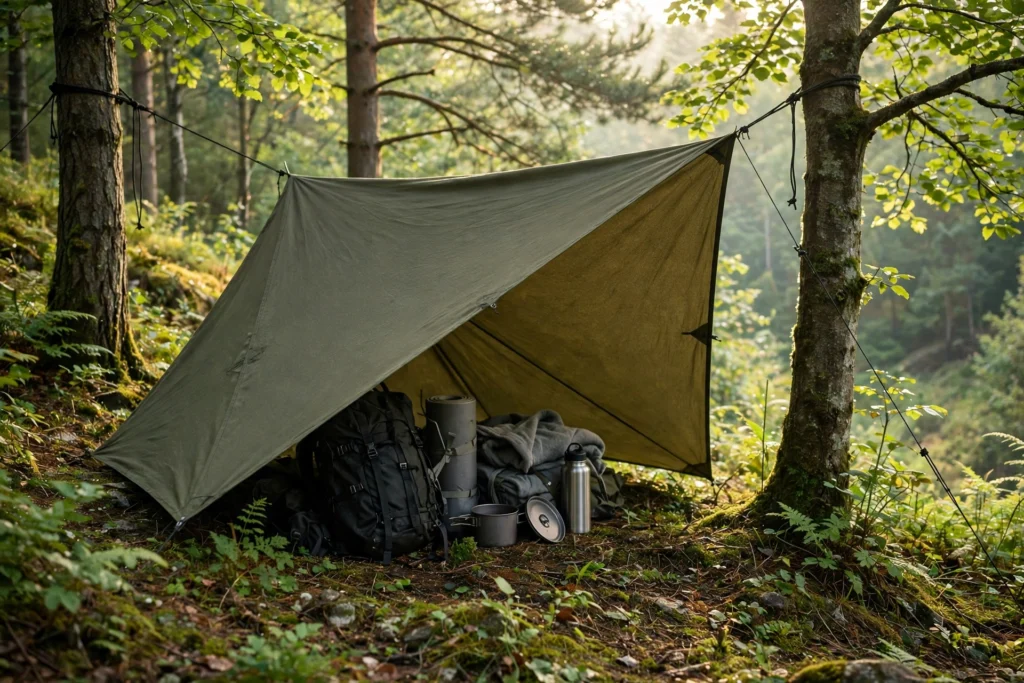
The 19 tie-outs are the story. Sixteen run around the edges and corners and three sit along the centre ridgeline, which is why the same tarp works as an A-frame over a hammock, a lean-to in front of a fire, a plow point when the wind swings, or a groundsheet when the ground is the problem. Owners who teach with it — bushcraft and survival schools are DD’s own example, and the listing’s 4.8 stars across 1,354 ratings back it up — praise exactly that: one tarp, a dozen pitches, nothing to learn twice.
The complaints are just as consistent. At 790g for the tarp alone, before pegs and lines, it is not a light tarp anymore — the SuperLight below is 300g lighter in nearly the same size. The included guy lines get called thin often enough that plenty of owners replace them with better cord in the first season. And the warranty is one year against manufacturing faults, the shortest cover in this comparison.
Pros: 19 tie-outs and a real ridgeline row; pegs and lines in the box; polyester holds its pitch instead of stretching when wet; the lowest price here for a complete kit.
Cons: 790g tarp-only; thin supplied guy lines; 1-year warranty; no finished-size figure published — DD lists the nominal 3m x 3m.
Buy it if you want one tarp that pitches every way and your carry is a pack, a car, or a bug-out bag rather than a thru-hike. Skip it if you count grams — read the SuperLight section first.
Verdict: The Defender is the heavy end of AquaQuest’s line: 70D nylon under a heavy TPU coating rated to 20,000mm, every seam heat-taped, 19 webbing tie-outs on the 10×10, and a lifetime warranty against defects in materials and workmanship. It scores 82/100 (8.2/10) — the storm pick, at $129.99, with a weight story that gets its own paragraph below.
That rating needs context, and the head-to-head section below gives it: past roughly 3,000mm, rain comes in at the open ends and under a high edge long before it pushes through fabric. What the Defender’s coating and heat-taped seams actually buy is a tarp that stays up for days at a basecamp or hunting camp without the seams becoming the story. The 10×10’s listing holds 4.7 stars across 1,966 ratings, and the praise pattern is storm survival — one owner AquaQuest quotes kept four people and their gear dry through two inches of Acadia rain under a bigger Defender.
The costs are plain. Weight first, because the sources argue: Amazon’s listing prints 2.4 lb for this 10×10, but AquaQuest’s own range statement puts 2.4 lb on the smaller 10×7 — so the 10×10’s true weight is more than the listing admits, and even the flattering figure is nearly double the Guide’s 1.3 lb in the same listed size. The box holds a tarp and a stuff sack — no stakes, no cordage. And 70D nylon melts: AquaQuest itself warns to keep every tarp well back from open flame, and spark holes are the recurring Defender complaint from owners who pitch lean-tos in front of fires.
Pros: 20,000mm coating with heat-taped seams; lifetime warranty; webbing-reinforced ridgelines; honest finished-size publishing (9 ft 7 in square).
Cons: The heaviest tarp here by a wide margin; tarp and sack only in the box; nylon and campfires do not mix.
Buy it if the tarp roofs a camp that stays up, rides in a vehicle, or covers a bug-out cache. Skip it if it has to live in a pack you carry for miles.
DD SuperLight Tarp — the light one that still brings its pegs
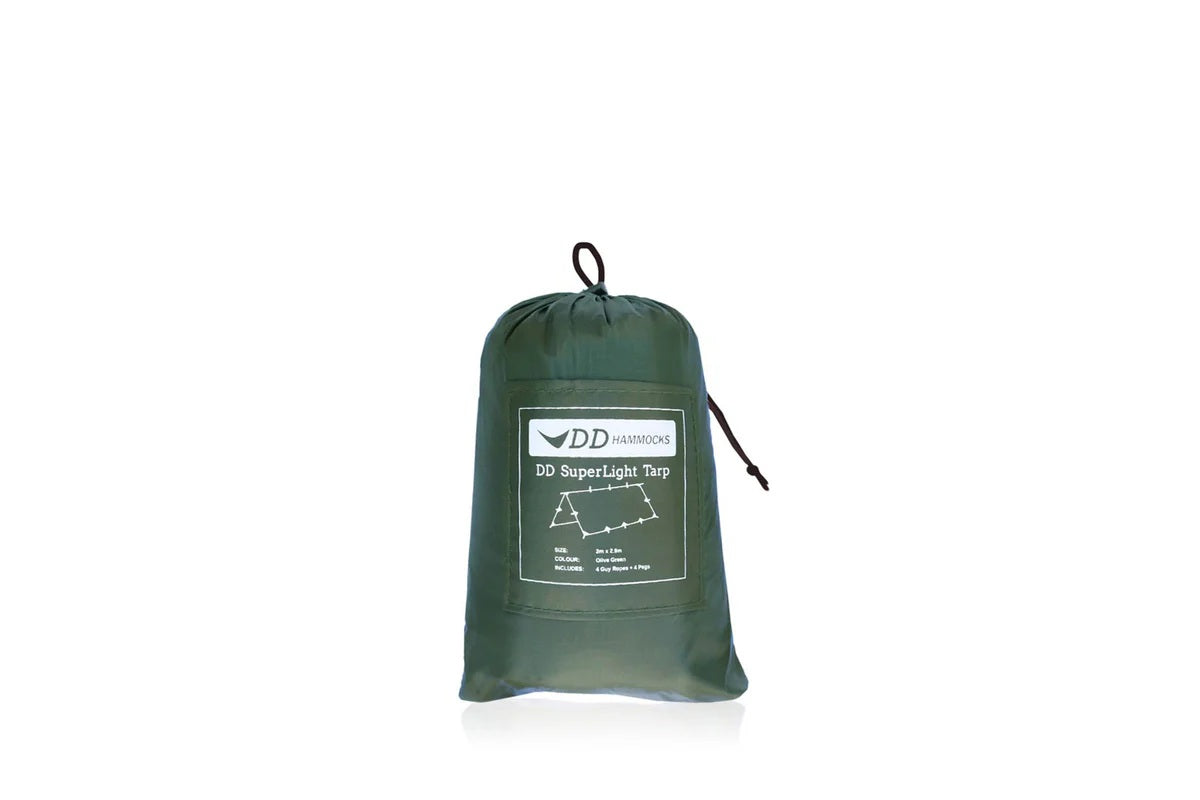
Verdict: The SuperLight takes the 3×3 pattern and rebuilds it in ripstop nylon: 3m x 2.9m, 490g for the tarp, the same 19 attachment points, the same 3,000mm PU rating — and it still includes 4 SuperLight pegs and guy lines, which no AquaQuest does. It scores 80/100 (8.0/10) at $101.64 for the olive green (a second colourway sat at $99.95 the same morning). One spec-sheet argument worth knowing: Amazon’s listing weighs this tarp at 460g against DD’s published 490g — the only number in this comparison where the shop disagrees with the maker, in the flattering direction. We print DD’s figure. Its listing holds 4.7 stars across 368 ratings.
That combination is the SuperLight’s whole case. It packs to 19 x 10 x 4 cm — jacket-pocket territory, in DD’s words — and it is the only genuinely light tarp here that pitches out of the box. Owners who walk distance with it praise the packed size and the familiar tie-out layout: every pitch you learned on the 3×3 works unchanged.
The trade is written on DD’s own care page, and we are quoting it because most reviews skip it: “Over time repeated fold lines can start to weaken the fine material” — stuff it, don’t fold it — and UV degradation is excluded from the warranty. Long-term owner reports on light PU-coated fabrics add the other half: coatings on this class of tarp eventually crack and need re-proofing after seasons of use. The 490g figure also excludes pegs and lines, same as its brother. None of that makes it a bad tarp; it makes it a tarp with a service life you manage.
Pros: 490g with pegs and lines included; 19 tie-outs, same pitches as the 3×3; packs to 19 x 10 x 4 cm.
Cons: Fine fabric with a fold-line weakness DD states itself; 1-year warranty with UV excluded; most expensive per square metre here.
Buy it if you walk to camp and want a complete kit under 600 grams as pitched. Skip it if the tarp will live pitched for weeks or ride out rough ground duty.
Verdict: The Guide is AquaQuest’s ultralight answer in the same 10×10 size: 40D ripstop nylon with silicone and PU coatings, rated 5,000mm, seams taped, 17 attachment points including a centre loop — 1.3 lb of tarp, with a 5,000mm rating and a lifetime warranty behind it. It scores 78/100 (7.8/10) at $129.99 — the same money as the Defender, spent on lightness instead of armour.
The Guide’s owner praise is one-note in a good way (the listing holds 4.7 stars across 949 ratings): “very light and packs down well” is the sentence AquaQuest quotes from a Guide owner, and the backpacking forums agree, putting the 10×10 at about 21 ounces and calling it the sturdy alternative to a Dyneema tarp at a quarter of the price. The ripstop grid matters here — 40D is light yarn, and the grid is what stops a snag from running the length of the panel.
Two honest limits. First, the box: tarp and stuff sack, nothing else — stakes, poles and cordage are yours to supply, so price the whole pitch before you compare it against either DD. Second, light fabric is a care commitment: pitch it tight so it doesn’t flog, and keep it off sharp ground. The lifetime warranty covers defects, not abrasion.
Pros: 1.3 lb in a 10×10; 5,000mm with taped seams; lifetime warranty; centre loop for hanging from a ridgeline.
Cons: Nothing else in the box; 40D fabric asks for careful handling; fewest tie-outs here (17).
Buy it if the tarp rides on your back and you already own stakes and cord. Skip it if this is your first tarp and you need the box to contain a working shelter.
Does a 20,000mm rating actually keep you drier than 3,000mm?
On paper the Defender’s 20,000mm dwarfs the 3,000mm both DDs carry — and in a lab it does. Under a real pitch, the Defender, the Guide at 5,000mm, and both DDs at 3,000mm all stop rain coming through the cloth; a 3,000mm coating already holds back a 3-metre column of water. AquaQuest’s own buying guide says it plainly: rain gets in at the open ends of an A-frame and under a high edge long before it comes through the fabric. What the bigger numbers buy is margin — coating thickness that survives days pitched, wet snow load, and years of folding — not a drier first night. Choose on finished size, weight, and what’s in the box; treat anything past 3,000mm as insurance, not the decision.
How much tarp do you actually get for the listed size?
Less than the tag says, and AquaQuest is the only maker here that prints the real number: its 10 x 10 tarps finish at 9 ft 7 in by 9 ft 7 in, whichever model you buy, because the listed size is the cloth before hemming. That missing 5 inches is a strip of splash zone on every side. DD lists the Tarp 3×3 and the SuperLight at their nominal 3m sizes without publishing a finished figure, so plan any DD pitch a few inches tighter than the tape suggests. Our Tarp Size & Cordage Calculator works from the people and the pitch rather than the tag — run your numbers there before you buy a size up or down.
What is in the box — and what do you still have to buy?
The two DDs arrive as shelters: tarp, 4 pegs, 4 guy lines, stuff sack. Add a ridgeline cord and you can pitch either one the day it lands. Both AquaQuest tarps arrive as fabric: tarp and stuff sack, full stop — AquaQuest’s own FAQ says to use your preferred poles, stakes, and cordage. That is a legitimate design choice for owners with a cordage kit already built, and a quiet extra cost for anyone else. A ridgeline, four to six stakes and a set of guy lines can add the price of a budget tarp to the Guide or Defender before either one spends a night up.
Which tarp pitches the most shapes?
On tie-outs, the DD Tarp 3×3 and the SuperLight tie at 19 — sixteen around the edges and three along the ridgeline — and the Defender matches them at 19 webbing loops on the 10×10, against the Guide’s 17. The count is close enough that the layout decides it: the DDs’ three centre-ridgeline points let the tarp hang from a continuous ridgeline instead of being draped over one, which is the pitch that handles wind best. Our guide to hanging a tarp walks through that ridgeline, the four knots, and the four pitches worth knowing, with the cord maths for a 10-by-10 worked out.
What breaks first, and what does the warranty actually cover?
Two different answers. On paper the AquaQuest pair win outright: a lifetime warranty against defects in materials and workmanship, against one year from DD. In the field, the failures owners actually report are mostly outside any warranty: PU coatings that crack and peel after seasons (the SuperLight’s fine fabric is the exposed one here, and DD excludes UV damage outright), spark holes in nylon pitched too close to a fire, and torn tie-outs on any tarp pitched loose enough to flog. The Defender’s heavy TPU coating is the most resistant to the first of those; no tarp in this comparison is resistant to the second. Pitch tight, keep distance from flame, dry before storing — that routine is worth more than the warranty gap.
Honest caveats
Three, and they apply to the whole class. First, hydrostatic-head numbers are lab figures measured on new fabric; no maker here publishes an aged-fabric figure, and coatings decline with UV and folding. Second, every weight in this comparison is a tarp-only weight — both DDs say so in plain text, and AquaQuest’s weights are for the tarp in its sack. Your carried shelter weighs more than any number in the table. Third, “100% waterproof” is a claim about fabric, not about a pitch: a badly pitched Defender lets in more rain at the ends than a well-pitched SuperLight. The tarp is half the shelter; the pitch is the other half.
Questions people ask about these tarps
What size tarp do I need for camping?
For one person plus gear, a tarp around 3m x 3m — the DD Tarp 3×3’s size — covers a hammock or a ground pitch with room to cook at the edge. AquaQuest’s own guide puts solo and hammock campers at 10×7 to 10×10, two people at 10×10 to 13×10, and says to size up if you expect wind or all-day rain, because a steeper pitch eats coverage.
Is a 3,000mm waterproof rating enough?
Yes, for rain. A 3,000mm rating means the coating holds a 3-metre water column before leaking, which is past what falling rain produces; both DDs carry it and are sold as storm tarps. Higher ratings like the Defender’s 20,000mm buy margin for snow load, long pitches and coating wear — worth having at a basecamp, not a reason to reject a 3,000mm tarp for camping.
Do these tarps come with stakes and guy lines?
The two DDs do: 4 pegs and 4 guy lines ride in the bag with the Tarp 3×3 and the SuperLight. The two AquaQuests do not — the box holds the tarp and its stuff sack, and stakes, poles and cordage are bought separately. Whichever you choose, none of the four includes a ridgeline; that cord is always an extra.
Can a tarp replace a tent?
For one sleeper in three seasons, yes — an A-frame or lean-to over a groundsheet keeps off the rain a tent fly keeps off, at a fraction of the weight, and our four picks all pitch that way. What a tarp never gives you is a bug-proof, enclosed room: in mosquito season a tarp sleeper adds a net, and in driven snow a tarp pitch is a skill, not a product.
How do I make a tarp coating last?
Dry it fully before storing, store it loose and out of sunlight, and stuff it instead of folding it — DD’s own care note warns that repeated fold lines weaken fine fabrics like the SuperLight’s, and UV damage is excluded from its warranty. A PU coating that starts to flake after years can be re-proofed with a tent-fabric spray; a torn tie-out cannot be sprayed back on, so pitch tight rather than hard.
Does silnylon really sag when it gets wet? Silnylon or silpoly for a tarp?
Yes — a silnylon tarp really does sag when it gets wet, and the makers who sew both fabrics say so themselves. Six Moon Designs, which builds shelters from silnylon and silpoly, puts it plainly: a silnylon shelter “does tend to have some sag in the fabric overnight,” and its fix is to re-tension the pitch about 30 minutes after setting up. Silpoly, by contrast, “has a very low stretch and deflection,” so the pitch you set is closer to the pitch you wake up under.
The reason is in the fibre, not the coating. Nylon takes up water — its moisture regain runs about 4 to 4.5 percent, against roughly 0.4 percent for polyester, ten times as much — and wet nylon lengthens and slackens. Rain does it, heavy dew does most of it, and a cold night adds slack of its own. Polyester barely takes water into the fibre at all, so a polyester pitch stays where you put it. That split runs straight through this comparison: the DD Tarp 3×3 above is polyester, and the other three — the DD SuperLight, the AquaQuest Defender, and the AquaQuest Guide — are all nylon under their coatings, so the sag-and-re-tension routine applies to them.
Living with a nylon tarp is a routine, not a repair: pitch it, re-tension after about half an hour, and snug the lines again when the rain starts or before you turn in. Elastic tensioners on the guy lines take up slack as it forms, which is the closest thing to a fit-and-forget fix. One honest limit on the other side: silpoly’s win is the taut pitch, not a dry pack — surface water still rides on a polyester tarp in the morning, and owners who use both fabrics find the drying difference smaller in practice than the sag difference.
So which one do you buy? If your trips are wet and multi-day, and you hate waking to a slack panel an inch from your face, polyester — silpoly in the ultralight lines — is the calmer fabric. If the tarp gets dragged, stuffed, and pitched over rough ground, silnylon’s tear strength is the better insurance; Six Moon Designs rates silpoly’s tear strength below silnylon’s. Sag is a chore you do twice an evening. A torn panel is the trip. Pick which problem you would rather own.
Keep reading
These tarps anchor our Shelter & Sleep hub. The skills half of this comparison is How to Hang a Tarp — the ridgeline, the knots, and the four pitches, worked out on a 10-by-10 like the AquaQuests here. The tarp is also one layer of the bag in our bug-out bag comparison, where the packed size of a shelter like the SuperLight earns its keep. And if you want to know how the scores above were built, How We Rate shows the whole scorecard.
Prices last checked: October 27, 2026. Prices and availability change; the prices shown were the Amazon prices on the morning this comparison was prepared. All four tarps had live Amazon offers that morning: the Tarp 3×3 sold by DD Hammocks ltd, both AquaQuests sold by AquaQuest’s own storefront, and the ones we checked fulfilled by Amazon.
Talk it over with other readers. The Shelter Tactics Community on Facebook is where readers compare notes on knives, lights, packs, and the rest of the kit — and where your questions help decide what we research next. Join the group →